Kamar Hamza
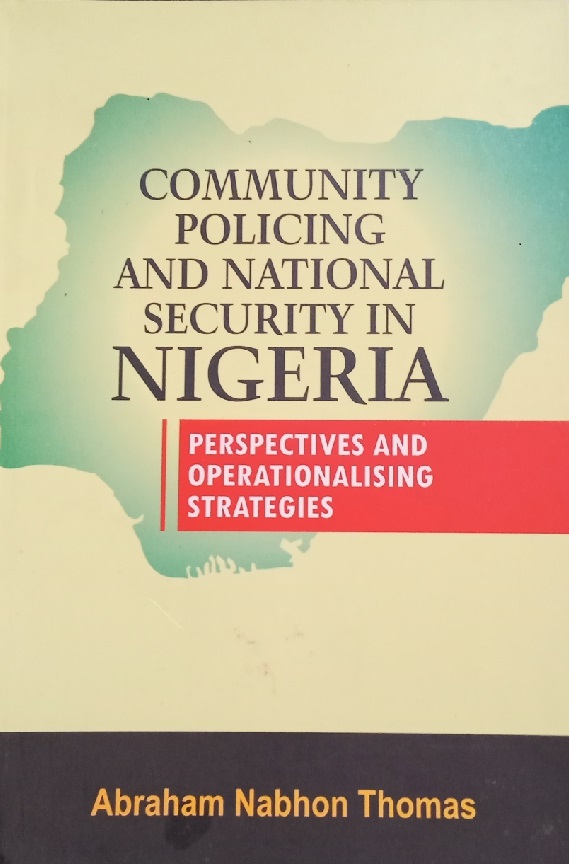
Security challenges around the globe have scaled up the engagement of scholars, writers, policymakers and practitioners in the security sector to theorise and tinker with ideas on how to combat and eventually prevent occurrence of security breach in the society. Abraham Nabhon Thomas book, Community Policing and National Security in Nigeria: Perspectives and Operationalizing Strategies is a very hard to respond to the challenge. The book outlines and discusses the operational strategies for not only combating security challenges but also preventing security breaches through the mechanism of community policing coordinated under the formal policy structure of the state using Nigeria as a case study.
The book has fifteen chapters and the first to the fifth are dedicated to the conceptual issues. The concepts dwell upon security, community policing, securitization and security governance. Obstructions to national security and a community policing system are discussed in chapter six along with national security doctrine and strategy in chapter seven using general systems theory as a framework for analysis. The theory was extended to chapter seven to discuss the delivery of the national security doctrine, which was narrowed down to crime policing methods and internal control in the system from chapter eight to twelve. Chapter thirteen and fourteen are preoccupied with modalities for implementing community vigilance for crime prevention through commitment by major stakeholders in the national security management structure in Nigeria.
Thomas posits that community policing is an intelligence-led activity that involves stakeholders who cut across,
A range of intelligence analysts including experts and professionals within and outside law enforcement community that have need for the intelligence products for immediate use to get discussions and actions and the whole community that benefits from the gains from the use of intelligence products (p. 200)
The author further outlines the stakeholders in groups within the society and the state:
The range of intelligence consumers at the minimum hold include the set of key players in community policing and security, viz: the police department, the community, the government and government functionary, the private and public business community, other agencies such as NGOs, CBOs, FBOs, CLOs, professional bodies and mass agenda (p.200)
The field experience of Thomas in the policing and security sector and the standard of interaction as well as scholarly study on the use of the book is registered in the book and the way he manages and explores the issues discussed. The author had excess information which were summarised in order to bring out congent and concise ideas needed for theorising on the two major issues that form the central themes of the book. In an attempt at summarising the issues explored from various credible sources he resorted to outline of points without thoroughly discussing some issues as expected from an outstanding expert
The author was able to cover a wide range of issues on community policing and national security in Nigeria by connecting the two central themes and isolating the first variable to explore issues of crime prevention through the involvement of a centralised policing structure and an informal community vigilante that could carry everyone along in securing communities and the country at-large. It identified that operationalizing the phenomenon of community policing as an aspect of change is expected to be designed and implemented by the police in order to create a better image for itself and enhance the role of the police as a major stakeholder in the national security architecture of Nigeria.
Thomas’s target is the security sector policy makers and intellectuals in the academia as such the language and style reflects the use of water pipes argument which is theoretical basis within the tradition of general systems theory. This point is illustrated in the except in the book.
The legal framework which is the foundation for the operational architecture therefore is devoid of structure and processes that would actuate preventive policy. Moreover, the statutory framework is fraught which conceptual and provisional contradictions and theoretical apathy. It is therefore expedient to address the foregoing observed incongruence in the ongoing process of security reforms in Nigeria (p. 133)
The language of research used in the passage above pays attention to the detailed description of the issue being discussed without being watery or verbose.The overall objective of expanding energy on writing about community policing and national security in Nigeria is to inspire
Community political will and operational leadership that can trigger community ownership, acceptance, support and integrated partnership in observable programs projects and processes of preventing and solving crimes problems are social disorder in the community (p. 257)
Thomas struggled to balance between erudition in scholarship and professional practice and the two were well balanced in the outcome. The book is an addition to the stork of articles and reports written on community policy and national security in Nigeria. This is the first comprehensive book on the topic.
Kamar Hamza is a lecturer in the Department of Political Science, Kaduna State University, Kaduna. He holds a PhD in Political Science from Ahmadu Bello University, Zaria. He was on Crossing Borders Creative Writing Mentoring Scheme of the British Council Nigeria (2003-2004). He writes poems, children’s stories and literary book reviews as a hobby.
 NIGERIA REVIEW OF BOOKS