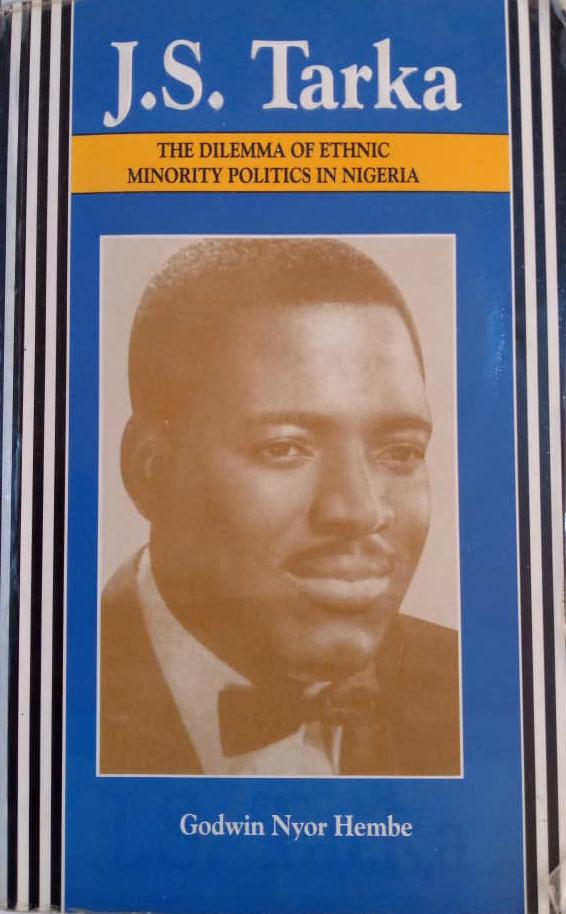
Book Title: J.S. Tarka: The Dilemma of Ethnic Minority Politics in Nigeria
Author: Godwin Nyor Hembe
Publishers: Aboki Publishers, Makurdi
Pages: pp. xxiv+453
Year: 2003
ISBN: 978-8098-03-7
This is a retrospective take on Professor Godwin Nyor Hembe’s magnum opus, published almost twenty years ago. It offers a fundamental analysis of Nigerian politics from the ethnic and minority perspective. G.N. Hembe (1944-2008) was a professor of political science at Benue State University.
The Nigerian story of politics is one in which the various peoples that make up the country live in suspicion of one another. The agency of fear more than any other lofty ideal being a major factor in the relationship that Nigerian ethnic nationalities have with each other. This state of affairs affects the way the government is structured and how the personnel in charge of the governmental apparatus behave in making policy and in the conduct of public administration.
The roots of this state of affairs go further than the colonial enterprise that many scholars often hold as responsible for Nigeria’s fractured inter-group relations. The colonial philosophy, policy and practice of divide and rule being only one facet of an equation whose existence is several centuries old. In the period before Europeans became a factor in Nigeria’s history and altered the nature of our society, and doing so profoundly in all ramifications, our prior existence was not that of an idyllic existence.
In Nigeria’s past, both internal slavery within the areas that became Nigeria and the external slave trade through the Atlantic and the trans-Saharan trade routes made for a fearful existence for many Nigerians. Venturing beyond one’s village or community in many places without adequate protection in the form of an armed caravan or group embarking on a journey was calling for seizure into slavery by another clan or group who may or may not speak your language.
The precolonial period was one in which broader ethnic kinship affiliation were yet to be taken for granted, a phase which would have to wait till the arrival of British colonialism and the centralization of administrative structures in Nigeria. Such a phase when it arrived highlighted and defined broader ethnic identification by groups speaking a similar language. Additionally, it created in-group identification for entities that were merged into a defined administrative district or province. The colonial phase also led to the explosive growth in the number of towns and cities across Nigeria and created an upsurge in opportunities for advancement that many Nigerians had before then had no conception of.
The swift marriage of a low producing system and a high producing one that was characterised by differences in high education and an advanced technology and the uses to which these could be put to had a defining impact on all ramifications of the life of Nigerians. Agencies such as the railways, the asphalted roads and motor transport did a lot to bring Nigerians of various ethnicities together than had hitherto been possible before 1900.
These developments made it easier for more Igbo, Tiv, Nupe, Hausa, Yoruba, Gbagyi to come together, initially, in areas they regarded as their homelands in the newly created clan or divisional headquarters, and then outwards to the provincial headquarters and the regional and national capital cities. Equally, the new nation of Nigeria that emerged after 1914 together with Pax Britannica made it possible for Nigerians from all parts of the country to migrate across distances and settle where in times past it would have been unheard of.
In this regard, even the existence of Sabon Garis as new settlement areas for migrants, organised apart from the old towns, represented a positive outcome that pointed to the greater integration and intermingling of Nigerians. Thus, taken as a whole, in a city like Kano, where there were no Igbo, Yoruba or Ijaw before, you now had them. In the south, the equal upsurge of the Hausa and other northern groups was consistent with the movement up north by southerners.
The emergence of cities, the upsurge in migration, the mixing of people and the introduction of politics to determine how the new Nigerians were to govern themselves created a potent mix of tension for the citizens of the new country; especially among the newly British created intelligentsia. A group which in many parts of Nigeria, except for the far-north with a rich intellectual tradition of clerics and learned men were a new specie. What G.N. Hembe would call the rise of the new men. Men and women possessed of a new type of knowledge, unknown before to their communities, and for which during the colonial era was unavailable to most of their kith and kin.
This new men and women were an elite minority poised to reap the fruits of a new system in a new nation, for which each of the ethnicities new men had to battle each other for the finite positions that were on offer in the politics of administering the new nation, with its agglomeration of resources at the centre in a national treasury. These resources were in the form of a purported “national cake” to be shared; rather than enlarged. It was also resources which could be utilised to fast-track development of one area over and above another given its limitedness. This is a point that need stressing, for at no period in Nigeria’s history were local or national resources abundant or even sufficient to meeting the development realities of a pre-industrial and barely literate populace.
Such an understanding is the point that Godwin Nyor Hembe’s J.S. Tarka: The Dilemma of Ethnic Minority Politics in Nigeria clearly illustrates with the example of the Tiv attempt to get to the heart of Nigerian politics. Hembe’s analysis chronicles the very nature of ethnic politics in Nigeria by focusing on how minorities agitated politically within the Nigerian state; especially, in one that despite being federally structured was not devoid of the element of fear that drives national discourse and politics. Hembe portrays the dilemma of minority groups lacking access to the levers of political authority, and feeling disenfranchised and marginalised.
Published twenty years ago, this major work is still vital to read for its timeless analysis. Hembe takes us from regionalism – to the creation of states – which opened up new vistas that made the old politics of pitting minorities of the north against the Hausa-Fulani to be obsolete. In the new states structure to first emerged in 1967 [with subsequent variations in 1976, 1989, 1991 and 1996], Hembe showed, first, that it is the majorities that increasingly contended against each other. And second that the old battle grounds with entire regions as the canvas had shifted to the state capitals where old minorities became majorities and new minorities were created. In the states, the local government areas ameliorated some of the fears of the new minorities, as they assured in principle, some form of self-determination at the local level.
The creation of states, however, did not preclude the dominance of minorities by the major groups and to solve some of these issues that arose which the mere creation of states could not solve was evolved the federal character system and the introduction of the zoning system formally and informally in the politics and socio-cultural life of the federation and states. In this too, Hembe showed how the Tiv zonal arrangement that was an age-long tradition could inform Nigeria about how to proceed. Yet, again, in the clash of modernity and tradition, and the rise of the individual, and also of ethnic nationalism it became difficult to subordinate self-interest for the collective one. A challenge that Nigeria now experiences with the zoning of elective offices in the Fourth Republic.
In the example of the preeminent Tiv politician of the late colonial era and of the First and Second Republics, Senator Joseph Sarwuan Tarka, Hembe showed how continually J.S. Tarka upended tradition by imposing candidates, some of whom were non-Tiv, and eventually his own son on the electorate. This was in spite of the subsisting Tiv zoning philosophy of Ya na angbian – literally to eat and give your brother – which had been part of the Tiv tradition for appointing chiefs and was helpful in the sharing of communal resources collectively owned by the community.
The Tiv as the political process evolved and in order to have less friction in the political sphere adopted their traditional zoning system as a means of allocating political offices among contestants such that where a particular district or local government area had produced elected or appointed office holders before, the choice would now be restricted to sections that had not benefited before. The process will then be rotated to all the eligible zones often without regard to the time spent in the position.
A fundamental criticism, however, of the zoning formula is its disregard for individuality, competency and the merit of those aspiring for elective offices in the modern era. Yet due to fear of one group perpetually dominating others politically, zoning and power rotation, is at the heart of Nigerian political discourse and political bargaining in the Fourth Republic.
What Hembe attempted to do in his magnum opus was to bring to the fore the logic that the British ethnicisation of the colonial geo-political and administrative landscape had no air of immutability. For the British it was a credible platform for governing a large territory with minimal human resources at their disposal; a policy without which they would have been unable to weld together the disparate vastness of a territory like Nigeria. It is now up to the Nigerian elite, to evolve a system that coheres the nation together.
The present national and states elite have a lot to learn from colonial era ethnocentrism, doing so to understand why ethnic-based administrative organisation was effective for British colonial administration. The drawback, however, was that in emphasising ethnic organisation of administrative units, the British unwittingly promoted unhealthy rivalry and the fear of others in the quest for political control at the regional and federal levels. In learning from what the British did, the Nigeria’s elite, should endeavour to seek out ways to build a national identity on the foundation of the ethnic one. Towards this, various cohesive and federal initiatives since the end of the First Republic have been adopted and implemented.
On the whole, therefore, to deny that there is now in Nigeria’s Fourth Republic a Nigerian identity in the sea of ethnicities is to deny the obvious. Though, again, the immutable fact of ethnicities been afraid of one another and seeking to collectively outdo and undo others is a trait influenced by enduring palpable fear ingrained in the Nigerian psyche with its obvious dangers that inclines more towards pulling apart.
It is these dangers that Godwin Nyor Hembe’s J.S. Tarka: The Dilemma of Ethnic Minority Politics in Nigeria warns Nigerians about. His clear analysis favours a broader, integrative national outlook by the political elite with limits on the usage of the ethnic card. Thus, what needs doing is for leaders to be assertive in the pursuit of patriotic, national and integrationist policies. It calls for the parties to continually downgrade the baser instincts of ethnic based politics with its obvious temptations, but hidden dangers
Terhemba Wuam is a Professor with the Department of History, Kaduna State University, Kaduna, Nigeria. He is co-editor of Challenges and Prospects of Development in Twenty-First Nigeria (Bahiti and Dalila Publishers, 2019).
 NIGERIA REVIEW OF BOOKS