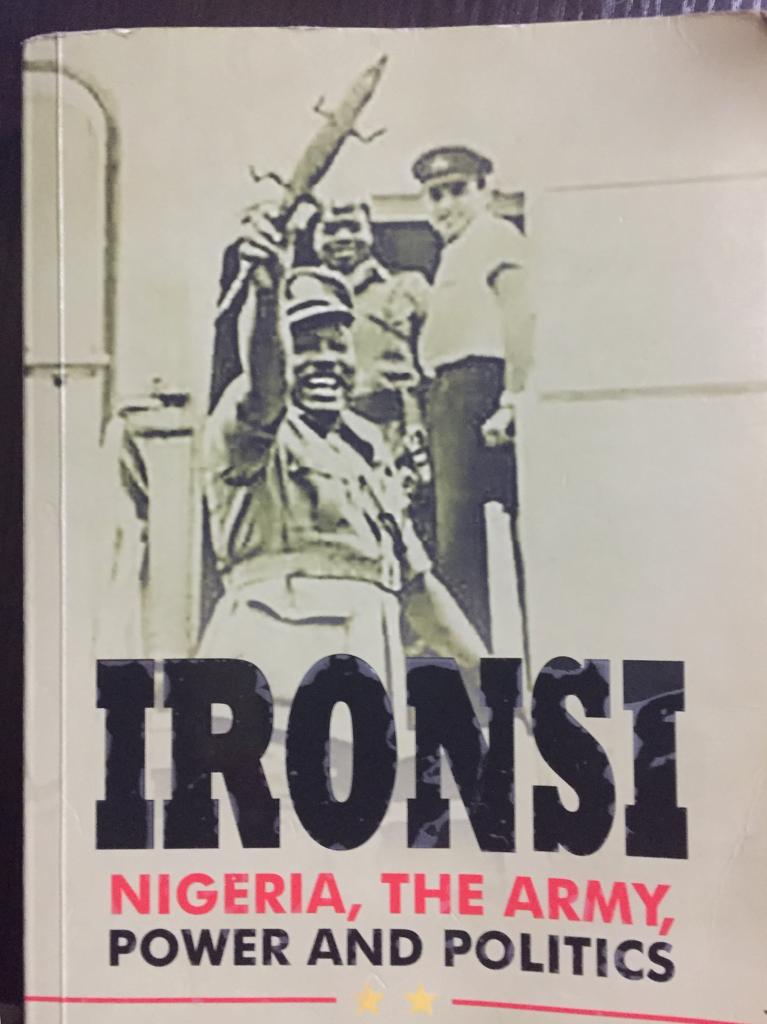
Book Title: Ironsi: Nigeria, the Army, Power and Politics
Author: Chucks Iloegbunam
Publishers: Press Alliance Network Limited
Pages: 298
Year: 2019
This book is indeed a worthy read for several reasons. A well written, balanced and illuminating account of a dark period in the annals of Nigerian history, especially about the role and misrepresentation of the first military Head of State, Major-General Aguiyi Ironsi, a man whose, ‘labour and service to his nation has always been poorly and negatively portrayed’ without any shred of justification. He didn’t plot any coup but became the main beneficiary of one and was consumed by another – all within a period of six months. Such was the lot of the man who assumed the headship of a rudderless country and in his attempts to stem the slide was killed in a most gruesome manner. Since his demise not much has been written about his desire to weld together a fissiparous country in common unity. This book is perhaps the first deliberate account to reflect on his desires, his actions and marginally his missteps in office before he was consumed in what some saw as his inevitable fate.
It bears noting that even though he assumed the leadership of the country at a particularly trying period, his hands were not soaked in blood, rather he rallied loyal troops with the support of several officers to put an end to the ‘revolutionary putsch’ of the popularly acclaimed Five-Majors. That act opened for him both the way to the zenith of political leadership in the country and a passage to his end: the dual carriage way couldn’t be predicted in the opening acts of the ‘play’. Everything he did just didn’t bode well. Both for the country and himself. He was viewed suspiciously and this earned him questionable references in a country torn apart by ethnic and religious cleavages. This suspicion was fuelled in part because he escaped arrest and possible elimination by the coupists and essentially, because he vacillated in dealing ‘decisively’ with the revolutionary officers who were clamped into jail and continued to receive commendable applause from a section of the press that hailed them as heroes and finally because of the unitary decree he enacted in anticipation of holding the country together from collapsing into turmoil.
That was not to be as it was a grave blow on the centre of gravity for his fledging government which was torpedoed in another military coup led by aggrieved military officers from the northern part of the country in a retaliatory strike for the killings of the near top echelon of the military and the cream of its political elites. For starters, Aguiyi Ironsi indecisiveness in handling the coupists was a huge error of judgement that blew both himself and his regime to the dustbin of history. That action opened the way for his justifiable removal from office, and the enactment of decree 34 equally sealed his fate. The question which the author failed to ask was what other options were available to him given the scenario before him?
Major General Ironsi was a man of sterling qualities, an achiever by all standards. His accomplishments, however, were obviated by both coups, the coup of 15th January and 29th July 1966. A man whose supreme qualities are currently buried with him. An officer and gentleman with the distinction of many first to his name. He was the first Major-General in the Nigerian Army. He enlisted as a private soldier in 1945 and steadily rose through the ranks to the apogee by the time of his death. Selected for short service course in 1949, the wind for the Nigerianization of the Army made his meteoric rise inevitable and achievable. Events beyond him thrust him forward both in the army and to the pinnacle of political power in 1966.
Before he became Head of State in 1966, he was the pioneer native General Officer Commanding (GOC) of the Nigeria Army. In 1956, he was appointed as extra equerry to Her Majesty Queen Elizabeth II of the United Kingdom. First ever Nigerian promoted to the rank of captain, first ADC to the governor-general, major, lieutenant-colonel, colonel, brigadier, first battalion commander, first military attaché to the Nigerian Diplomatic Mission in the United Kingdom, first ever Nigerian commander of a United Nations contingent. During the UN operation, he was awarded with a medal of honour on account of his service to humanity and unfeigned valour in the face of mortal danger during his tour of duty to the UN mission in the Congo.
Sadly a detailed analysis of his career trajectory and eventual ascendancy to the headship of the country made him a scapegoat for actions hatched by ‘dissident officers’ mainly from his ethnic group but of which he rallied loyal troops to crushed. Though marked for elimination himself, his escape from sudden death is attributed by some as facilitated by the coupists. His escape hailed by some as by a stroke of luck was ridden by spurious and baseless accusation which made his steps in office marked with suspicion and spurious allegations all designed to pull him down and ensure his efforts at nation-building came to nought.
The book is an answer for some knotty questions, the years of objectionable silence, sacrifices and achievements and eventual martyrdom of this soldiers’ solider has being answered. The time for an objective evaluation of our nation’s past is inevitable and compelling as scholars are yet to proffer plausible explanation for how his demise was provoked by the vortex of inordinate power play within the army and by extension the nation. He served with the best of intentions, strived hardest to weld a fissiparous and disunited country in the image of a centralized command structure of his profession. By signing decrees 34 of 1966, he played into the hands of his political adversaries. The void and flagrant revisionism of our past has made the continuous slide to anomie attractive. This book is a light to unearth our country’s past often immersed in needless controversies and unacceptable ignorance thus permitting a climate of revisionism to be fostered on the country. The author in twenty-one chapters strove to weave a story about Major General Aguiyi Ironsi and Nigeria that requires deep reflection and provides answers to the past, albeit a dark past of a country still in search of redemption in the post-independence era.
Rotimi Olajide Opeyeoluwa is a lecturer in the Department of International Relations and Diplomacy, Afe Babalola University Ado-Ekiti, Ekiti State.
 NIGERIA REVIEW OF BOOKS