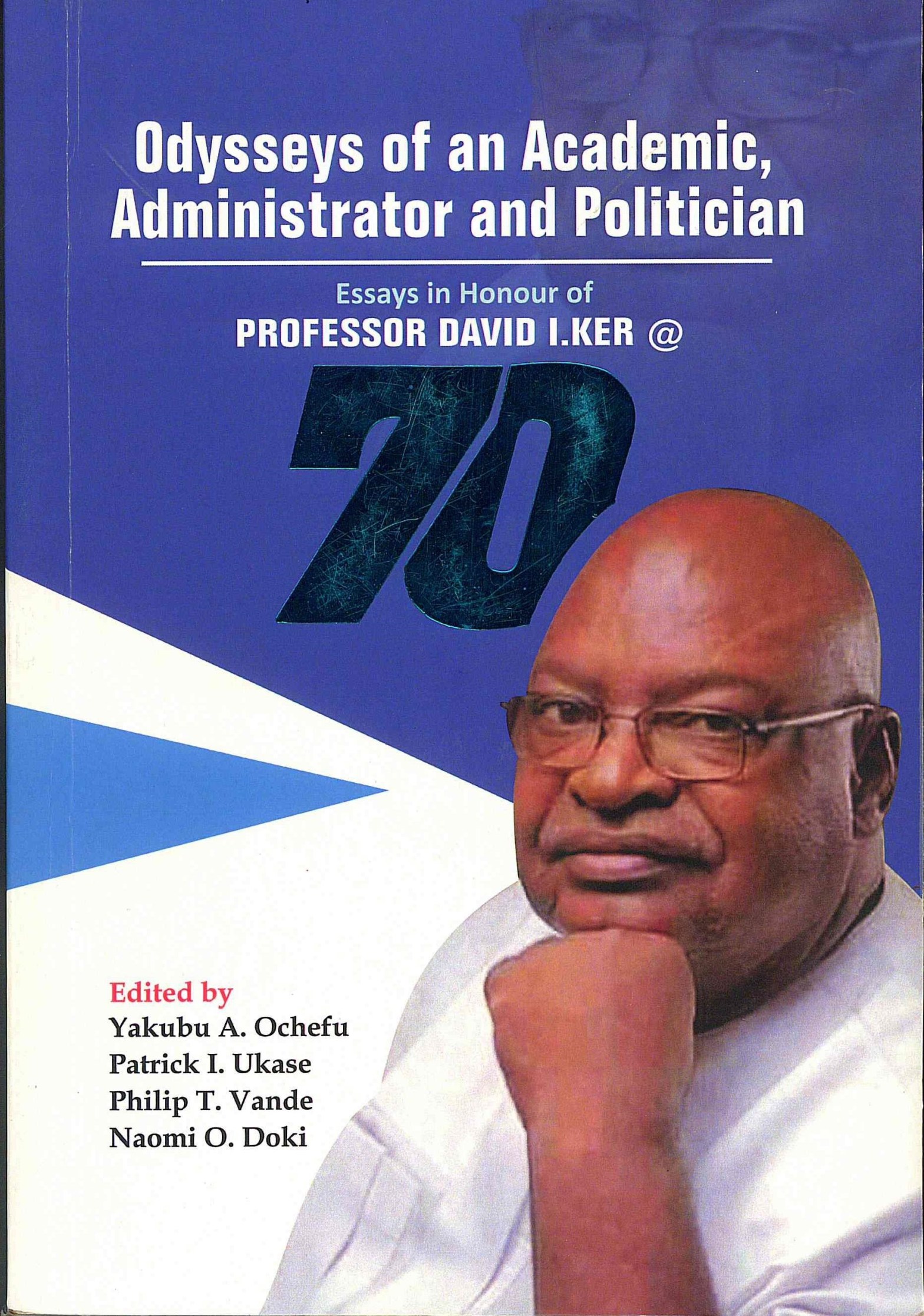
David Iyornongu Ker: A Man of Letter’s Role and Impact
Terhemba Wuam
Introduction
The time is ripe for an appreciation of the role of Professor David Iyornongu Ker in the intellectual firmament of Nigeria. Such an attempt calls for first, an appraisal and evaluation of his impact on literature in Nigeria and, second, his contributions to educational administration in the country, especially in the running and management of universities. At 70 years now, David Ker had never really left the university since he arrived at the Ahmadu Bello University (ABU) campus in 1971 when he was 20 years old. His has therefore been a life dedicated to letters and the university in Nigeria.
While in the academia he would marry his wife, Professor Beatrice Onyi Ker, a professor too, of Educational Guidance and Counselling, in 1979. Their union has been blessed with four children – Terrumun Ker (18 September 1981), Tavershima Ker (13 February 1983), Erdoo Ker (4 January 1985) and Ker David Ker (5 July 1986). For his services to education, Professor Ker received the award of Best Vice-Chancellor Nigerian State Universities in 2003 from the National Universities Commission (NUC) and was awarded the national honour of the Officer of the Order of the Niger (OON) in 2005 by President Olusegun Obasanjo.
Early Life and Education
David Ker was born on 6 June 1951 in Makurdi. The town of Makurdi, then classified as a second class township was the headquarters of Benue Province. His mother was Margaret Nguenyi Ker while his father was Mr. Ker Denor whose ancestral home was Abenga village in Mbabur, Ingyohov clan, which is now in Gwer East local government area of Benue state, but was then within the Tiv Division, which today embraces the 14 local government areas in Benue state and was administered by the Tiv Native Authority.[i]
His primary education was quite peripatetic. A village boy staying with his uncle, he started his primary school initially at Agagbe where they were based. Before he was done with schooling at the elementary level, he had attended three Catholic primary schools. The first was St. Francis Primary School in Agagbe, now in Gwer West local government area,where he started, then in 1958 moved to the Roman Catholic Mission (RCM) Primary at Tor-Mkar and concluded his primary studies at St. Patricks Primary School in Taraku in 1963.
It is interesting to note that in 1951 when David Ker was born there was only one university in Nigeria. The University of Ibadan then known as University College. It had been established in 1948 and affiliated to the University of London. And, in the whole wide territory of the then Northern Nigeria Region, there was no similar institution, and the first was come only eleven years after in 1962 when Ahmadu Bello University was established. Aside the limited presence of universities, the state of other levels of education in Nigeria was also basically at foundation level.
His secondary education at Mount Saint Michael’s Secondary School, Aliade began in 1968. It was quite different from that of his primary education in its stability. He was able to spend the required five years from 1964 to 1968 in Aliade, Benue’s preeminent Catholic secondary school. The college was founded in 1953 at Korinya in present-day Konshisha local government area with Rev. Fr. Henry Pass, CSSp as pioneer principal before it was then moved to Aliade within a few years of its establishment.[ii] Later in life, in 2007 at a conference on Catholic education in Benue State, David Ker would acknowledge the significant contribution that the Catholic Church had made to education in the state with its numerous primary schools and over 40 secondary schools. Stating that the Catholic church role in education has been of vital importance to the state through “the sheer numbers and the high quality of performance in the last fifty years,” which would “justify the claim that Makurdi Diocese is the great pillar on which the educational progress of Benue rests.”[iii]
Mt. St. Michael’s Aliade was a secondary school for boys and David Ker was one of 66 boys admitted in 1964. The school admission policy was eclectic and drew in students during the colonial period from across Nigeria, a policy sustained after independence in the First Republic. Though a large proportion of the students were from within Tiv division and Benue province, a significant proportion were from other parts of the country. There were Southerners and Easterners and several Northerners from other provinces.
The college like the other pioneering secondary schools in Benue has made a fundamental contribution in the development of the advanced human resources that were needed for the modernization of the Nigerian society. Among its sterling alumnus, of whom, David Ker could be counted as a preeminent one, had been men whose contributions to the nation has resounded in all sectors of national life. Alumnus through the civil and military eras have included former senators and other legislators at state and national levels, national party leaders, state governors, top military and police/security officers, executive council members and other top political appointees, business moguls and captains of industries, traditional rulers, high-ranking clergy – that includes a cardinal of the Catholic Church, bureaucrats and distinguished intellectuals and academics.[iv]
Although 13 years would look quite old for entrance into form one in 2021, which highlights the advances that the people of Benue and Nigeria have made in educational attainment, whereby it is now a rite of passage for parents and pupils without any second thought. But in 1964 at the then age of 13, David, could still be described by Toryima Emmanuel Jenkwe, a classmate and later academic, as “small and so fragile-looking”. Others in this group of fragile-looking entrants in 1964 to Aliade were personalities who also like Ker went on from Aliade to succeed in various professions, and who by their names indicate the diversity that was Aliade. For instance Dr. Sidiku Salawu, who became a consultant-surgeon with practice in Kaduna, Prof. Ignatius Uva who was also a distinguished academic and university administrator, and Mr. Samuel Ofoegbu, who would serve as a deputy registrar of the University of Nigeria, Nsukka.[v]
Though young for his age in 1964, according to Jenkwe, what saved David Ker from “the capricious wrath of the bullies, was the total absence of hubristic arrogance in him.”[vi] Ker, despite being a talented scholar in Aliade was unassuming and friendly, traits that were disarming as well as inviting, enabling him to get on well with others.[vii] His time in Aliade is described by Agbakor as being one where the subject “was the rare positive combination of multifarious characteristics of curiosity, hard work, humility intelligence, friendliness and self-confidence,” traits that were reflected in his emerging in 1968 with Division One in the West African School Certificate. From Aliade, David proceeded to Jos, the capital of the then Benue-Plateau state to attend St. Louis College for the Higher School Certificate (HSC) from 1969 to 1970.[viii]
The next plank on the intellectual ladder for the young David was gaining admission to Ahmadu Bello University, Zaria in 1971. At ABU, while studying for a degree in English he had a well-rounded academic and social life. The great volume of books in the library was a delight to him, it served him and others as Jenkwe, his mate again in Zaria, observed, as a vast intellectual menu upon which they could feast in the attempt “to try to quench the unquenchable thirst that had been aroused in us.”[ix] At ABU, David Ker’s interest in the analytical aspects of the works of writers of different hues, both European and Africans alike as Joyce Cary, Ayi Kwei Armah and Ben Johnson ignited his interest in literary criticism. His concern being with characterization, story theme, and period dramas.
David was and still is a voracious reader, and even though he was not too fond of texts for examination, he was a lover of the big classics and his favourites were Moby Dick and Vanity Fair among others. His approach to reading was strategic, even though as “a bookworm” he “had no problem about reading.” These aspects would serve as the foundation for his later flourishing as a critic of world renown.[x] He considered literary criticism and the critic’s role as being in the aid of the production of good literature. His view developed later on was that: “If the critics shy away there may also not emerge a strong literary culture… Only a strong critical tradition can point the way to standards for our emerging writers.”[xi]
At Ahmadu Bello University, he met Professor Olu Obafemi, with whom he would particularly form an enduring friendship. He had met with Obafemi in 1972, when the latter came to their drama group as a freshman, as he was a year older than Olu Obafemi in the university. The ABU of their days was a multicultural community of diverse groups with the Department of English having an equally broad curriculum that covered Modern European Languages. It was a community that was built on intellect, ideas and talent and in which the best thinking circulated freely. Apart from Obafemi, others in their group of friends included their teacher Aderemi Bamikunle and fellow students as Kolawole Ogungbesan, Yakubu Nasidi, Iyorwuese Hagher and Jimmy Atte, who all became distinguished academics and professionals.[xii]
Ahmadu Bello University provided a challenging and fulfilling academic environment for the young scholars. David Ker by virtue of the excellent quality of secondary education available to them, in the 1960s, and especially to him from Mt. Michael’s Aliade; he and the other undergraduates had gone to Zaria as confident young men and women. For David, at Aliade, students by the time they were in Form 3 had mastered basic grammar and in the 1960s/1970s university lecturers had no need to teach undergraduates how to construct sentences. They were readily prepared for the advanced learning of university life. Their lecturers were a mix of Africans, Britons and Americans who really worked hard to educate them.
A unique characteristic of ABU then was the large proportion of expatriate academic staff. The period of 1971 and 1974 that David was in ABU was one in which the Nigerian academic staff strength was about three out of a probable 19-20 academics. This dominance of expatriates and their pedagogical orientations made David to feel that the training was purely to turn them into European men. Notwithstanding this pedagogical orientation, they learn quite a lot from them, and the education they received provided the platform with which they were to liberate their literature and get it down to earth, especially when they, as former students began to assume academic positions in the department.[xiii] As David Ker would note in 2006 while delivering the lead paper at a conference on northern Nigerian literature, the country’s writers especially those of the north needed to also tell the region’s stories, just as William Faulkner has done for the American south.[xiv]
Having earned his Bachelor of Arts at Zaria, David Ker’s further education would continue beyond the shores of Nigeria at the University of Sussex in Brighton, England in the United Kingdom. In the 1976/1977 academic session, he had registered for the M.Phil./Ph.D. programme at the University of Ibadan and had started working with Professor M.J.C. Echeruo, his supervisor on a consultative basis as there was no course work for the programme. All he had to do was to work and present scholarship that was of an acceptable quality to a panel who will then decide whether he was to proceed on to the doctorate. However, within a year of beginning the Ibadan programme, he was to suspend it because of a scholarship he had won for postgraduate studies in United Kingdom.[xv]
By virtue of the merited Commonwealth Academic Staff Scholarship won in 1977, he went to the University of Sussex to study and earn the Master of Arts degree in African Studies by 1978.[xvi] The African Studies programme at Sussex was a new concept that devolved around African regional studies. Although it was not an English studies programme, due to his background in English and Literature, Ker was still allowed to focus on literature. Thus, his dissertation was built on Ayi Kwei Armah, the Ghanaian writer, who had continued to interest him, since his undergraduate days at Zaria. His thesis would be titled “History, Metaphysics and the Pan-African Ideal in the Novels of Ayi Kwei Armah.”[xvii]
In the thesis, supervised by Adrian Crewe, Ker explored Armah’s corpus of The Beautyful Ones Are Not Yet Born, Fragments, Why Are We So Blest?, and Two Thousand Seasons. In critiquing this important African writer he concluded that little changed in the nature of his writing over the space of 13 years. Presenting a general overview of African writers, it was his opinion that:
“The advantage at their disposal is the fact that there is so much retrieval work to be done in African history, a job very suitable to their subjective imagination. African history like any other history is beset with contradictions and untruths – in this respect even more than any other history because the issue of racism has always turned the ‘facts’ against the Africans.”[xviii]
Essentially, what the African Studies programme did to David Ker was to equip him with the analytical tools and perspectives to understand the African political economy in a manner that would not have been possible without the benefit of the Sussex MA.[xix]
While he was at Sussex, his friend Obafemi was also in the United Kingdom at Sheffield, and he made out time to visit him. This continued their intellectual partnership formed during their undergraduate days at ABU. A partnership that would extend into the twenty-first century. Several decades after their partnership had begun, Ker and Obafemi were still collaborating; in 2000 Ker wrote of their proposal for a book on “Post-coloniality and African literary aesthetics” which they had discussed at Ilorin, “In between having a breakfast of rice and beans,” where they “had agreed on all the details of the book.”[xx]
David Ker would return to the United Kingdom again, but to Scotland, in 1982 and stay on till 1984 at the University of Stirlingfor a doctorate degree in English Literature. This had been made possible by a scholarship awarded to him for that purpose by the Benue State Government in addition to a fellowship given to him by Ahmadu Bello University to undertake the doctorate at Stirling. To earn his doctorate and return to Nigeria he would eventually submit his major examination of aspects of the literary works done by British, American and African authors with the title of “An Examination of Point of View in Selected British, American and African Novels” in 1984.
An Academic and Intellectual Life
David Ker’s life’s work have always revolved around education. Right off from completing his Higher School Certificate he found himself engaged as the English Master at Government Secondary School, Kuru in Plateau state. An occupation which was basically a stop-gap appointment till he went to university and which lasted for nine months from January to September in 1971. The next step in his working life was to be during the period of his National Youth Service Corps after his graduation from Ahmadu Bello University. After ABU, he was posted to Lagos state for national service, which was from 1974 to 1975. In Lagos he served as English Master at the Jibril Martin Ahmadiyya Grammar School. David’s was the second set of NYSC, which had only been introduced by the Yakubu Gowon administration the previous year.
It was an eventful service year in which he made the friendship of Jide Alo, a fellow corps member posted to the Jibril Martin Ahmadiyya Grammar School. Jide had graduated with a second class uppers degree in Chemistry and they got along marvelously. Both were curious young men who always found time to read broadly as well as consuming the newspapers and magazines of the day. During the service year of 1974/1975 he had the opportunity to meet the governor of Lagos state, Brigadier-General Mobolaji Johnshon, who left a deep impression on him. Of particular importance to him was that Johnson was an avid reader of books and had made a list of books which he was reading. A list he shared with the corps member and of which he highlighted that his favourite book was The Peter Principle, a management book written by Laurence J. Peter and published in 1969.[xxi]
Next to the governor, he equally found the commissioner of Education, the late Chief Adeniran Ogunsanya to be a savvy and interesting personality. His opinion of these leaders and their impact in that year in Lagos was that: “Both these men made our corps year a delight because they encouraged reading and showed in their discourse that they lived by example. As a young graduate of English you can imagine my pleasant surprise to discover that our leaders also read.”[xxii] Though David Ker was to note that much had changed in the nature of citizens loving books, whereby he cited Eyo Willy more than three decades later who posited that: “The problem of this country is that we don’t read books.”[xxiii] An unfortunate situation whereby the leadership was no longer reading and students were only interested in passing examinations without the benefit of reading.[xxiv]
The early love for books by David Ker imbued him with its transformative powers and his constant refrain for citizens, especially the leadership was that they should read. This was because “Reading involves sharing. You do not only share the worldview of the writers you read you are obliged to share such a world view with others around you.”[xxv]
Tied to the problem of reading has also being the problem of the educated African and what his role in society is supposed to be. In his MA thesis he agrees with Mbella Sonne Dipoko whom he quotes thus: “The educated African, especially when he is a writer, seems to recoil from all the education he has got, to reject its authority and to seek his happiness, his peace of mind, his mission in a retrospective dream.”[xxvi] Embedded in this was another major challenge for African writers which was that ironically their privilege of possessing knowledge was circumscribed by the fact that even as they write about what they know it was “sure to reach only a small percentage of the population.”[xxvii]
For David, their love and habit of reading broadly and widely would prove crucial for him. It was during his service year, while reading The Daily Sketch that he saw advertised, a call for an assistant lecturer position in Literature at the University of Ibadan. He informed his friend Jide Alo of the opportunity and of his intention to apply and mailed in his application.
On the basis of that application, he was invited for an interview at the University of Ibadan. On the interview board was a panel of four professors and two senior lecturers. His performance during the interview was commendable and he was given the position of assistant lecturer to teach English Literature in the Department of Adult Education in 1975.[xxviii] A situation that was highly favourable to him as a similar outcome for him at Ahmadu Bello University would have been that of a graduate assistant. Ibadan where he resumed in the mid-1970s was a great institution with all the great names. And to David Ker, “Teaching in UI opened doors for me.” The scholars at Ibadan made him to feel at home both there and at Ife, which was to greatly benefit his development as a scholar.
David considered the appointment at Ibadan his “greatest moment” and was ready to learn from the professors who were equally happy to be his mentors such as Professor Ayo Banjo, who offered encouragement. When he became the vice chancellor of Benue State University he choose to emulate Professor Banjo. This was in the sense that later when Ayo Banjo became the vice chancellor of University Ibadan, he still found time to go to Ahmadu Bello University to examine a PhD thesis in the Department of English. Thus, according to David Ker, “When I became a Vice Chancellor several years later I used my mentor’s good example to continue with my academic work, teaching undergraduate courses and examining students whenever I was given the opportunity.”[xxix]
Professor M.J.C. Echeruo, was another mentor he looked up to. Prof. Echeruo had started supervising him in 1976 before he left and went to Sussex for African Studies upon receipt of the Commonwealth Academic Staff scholarship. Before moving to Sussex, his supervisor and academic advisers at Ibadan had already been working with him to fine-tune his dissertation ideas. For instance, in 1976, he met Professor Sam O. Asein in his office to discuss with him his thoughts on a possible study of comparative literature with attention to the Francophone, Caribbean and Anglophone literatures, the senior academic took the opportunity to go with him to the Common Room. They had coffee and “moi moi” as Professor Aseinhelped him to sharpen his ideas while introducing new perspectives.[xxx]
Twenty years after that very regular fare of “moi moi” with coffee, David the scholar and literary critic would return to Ibadan in 1996 with another request for Professor Asein.This time it was for the academic guru to pen a blurb for Professor Ker’s magnum opus The African Novel and the Modernist Tradition, to be first published in 1997 with subsequent releases in 1998 and 2000. On the occasion of the second time, both men, now professors retreated again to the same common room, and reminiscent of the first interaction, coffee and “moi moi’ was again on their menu.
Ker had been willing to learn from these mentors and to him “My life as a scholar would not have been the same,” without that mentorship.[xxxi] On the blurb of The African Novel and the Modernist Tradition Professor Sam O. Asein will write that, “There are very few African literary critics today who either by their formal training or persistent research can claim desirable competencies in coping with the rigours and challenges of serious comparative analysis such as Dr. Ker has undertaken.”[xxxii] He will further add that “This book is the outcome of an imaginatively conceived, thoroughly researched, and meticulously executed project. It is bound to extend as it should the frontiers of our knowledge of the modernist tradition and its relevance to African literary creativity and scholarship.”[xxxiii]
The impact of The African Novel and the Modernist Tradition was felt internationally. And closer home, it influenced the brilliant work of Dr. Ferdinand Iorbee Asoo, who taking off from Ker produced a wonderful work of literary criticism inThe African Novel and the Realist Tradition published in 2006. Asoo’s work is an authoritative interpretation of the canon of the African novel in the realist tradition as opposed to the modernist tradition espoused by David Ker. Dr. Asoo was to acknowledge his intellectual debts by expressing in the book his “most sincere gratitude to Professor David Ker, who not only oversaw the general progress of the work but demonstrated an extra-ordinary interest in it.”[xxxiv]
In 1979, after the completion of the MA in African Studies he returned to Nigeria and resumed at University of Ibadan. His return to Ibadan, however, was to be very brief. Within a year he would transfer his services to his alma mater Ahmadu Bello University to resume as Lecturer I. On his return to Ibadan, he had briefly considered continuing with the M.Phil./PhD programme under a new supervisor, Professor Dan Izevbaye. David recalled that when he informed Professor Echeruo that he was transferring his services to ABU, what Echeruo did was to call Professor Izevbaye and enquire from him, “How can you allow this boy go.” To which the latter’s reply was “That is what he want, so what can I do since that is his wish.”[xxxv]
Having left Ibadan, David Ker found himself moving back to base. Despite the scholarly advantages that Ibadan had offered, the key fact about Zaria to him was that he was back home in the Department of English. In Zaria he also became part of the process that brought about a different pedagogical perspective from the ones that the expatriates had offered students in the Department in 1970s and early 1980s. He would also be at the centre of the intellectual and scholarly life of the ABU English Department with his editorship of the Department’s journals such as Saiwa (1984-1986)and Work-in-Progress (1986-1989) alongside the performance of other related administrative responsibilities such as deanship of faculty and the Student Affairs Division among others. He went to Zaria as Lecturer I in 1982 and left in 1992 as a Reader to take up appointment as Professor of English at the newly established Benue State University, Makurdi.
Benue State University Makurdi and Beyond
The move to Makurdi in 1992 was leap of faith and the opportunity for a completely different intellectual adventure. As pioneers, he and other colleagues from ABU and other universities in Nigeria had returned back to Makurdi to establish Northern Nigeria’s first state university under the Rev. Fr. Moses Adasu administration as governor of Benue state. They with Professor Charles Gbilekaa Vajime who served for eight years as vice chancellor were the pioneers who established the first state university in the North on a sound footing. He began as head of department and dean of the Faculty of Arts before eventually becoming vice chancellor in 2000.David Ker in a memoranda to the 2007 visitation panel to Benue State University headed by Prof. J.O.I. Ayatse praised the pioneer vice chancellor for laying what he considered to be a solid foundation for what was a “young but promising University,” further observing that: “Professor Charles Gbilekaa Vajime laid a solid foundation for the University since it took off in 1992. Within his eight years tenure he gave the new University a positive image. His tenure witnessed regular sessions and there was a tradition of effective teaching.”[xxxvi]
While in Benue State University, he was appointed to serve as commissioner of education from 1994 to 1997 before returning to the university. According to him the experience of serving as a commissioner was to prove helpful, when he became the vice chancellor. This was because it had enabled him to know the intricacies of governance and political administration and how to relate with the state executive, especially the governor, where it was important to know where the governor stood on matters and to establish a working relationship with him that could yield results. He observed, however, that “We are actually sure of our place in society, but we sometimes have to ‘stoop to conquer’.” A strategy which was despite the best intentions “not always successful.”[xxxvii]
Because of the foundational work that the prior administrations of Vajime, Ker and Professor Paul Akase Sorkaa had done, Ker was to acknowledge the tremendous role that BSU was performing in the developing of higher level man power for the state and Nigeria. By 2012, BSU had produced over 100 doctorate graduates and had retained over 80% of them with another 20% teaching in other universities in the country. These figures have only continued to grow in significance and importance.[xxxviii]
When his tenure in BSU ended, he took a sabbatical at the National Universities Commission (NUC) which became extended, and at the end of it, he received a special commendation from the executive secretary of the NUC for his services to the NUC and the Nigerian university system. After the time at NUC, he would be called upon again to render further service as a vice chancellor. This time it was appointment as vice chancellor of Veritas University, Abuja, which was the Catholic University of Nigeria, started with its takeoff campus at Obehie in Abia state.
His appointment as the second vice chancellor of Veritas University which was licensed as the Catholic University of Nigeria by the National Universities Commission in 2007 was from 6 December 2010. Veritas vision was “to contribute to the development of a well-coordinated effective Catholic University that will achieve excellence in teaching, learning and research through the development of high quality human and material resources relevant to the national development and the production of graduates with the highest standards of knowledge, skills and moral development.”[xxxix] During his time at Veritas, which was to reorganize the institution, which he was able to do so by working with the university’s stakeholders, Veritas was able to address critical issues of funding and also secure NUC accreditation for the courses that the university was offering by the time he left as vice chancellor in 2012.
In BSU and Veritas David Ker management style was one of consensus. He adopted the time honoured university committee system and applied it innovatively in the process of implementing the initiatives he and his management team supported by Professor Yakubu Aboki Ochefu, the deputy vice chancellor had designed for the transformation of Benue State University into a leading university in Nigeria. David Ker’s view on the committee system as applied in Benue State University was that, “The Committee system worked wonderfully… to produce the prominence that BSU enjoyed in the years 2000-2005.”[xl] His partnership was therefore with fellow professors, academics, administrators and their representative unions. In this regard, he noted that: “When I was leaving Benue State University in 2005, the Academic Staff Union of Universities (ASUU) [BSU Chapter] gave me a send forth and if you witnessed it you could be excused if you left with the impression that I was the Chairman of the chapter and not the Vice Chancellor.”[xli]
Impact and Conclusion
Professor David Iyornongu Ker was certainly part of the first generation of his people to have access to university education if we broaden the span of a generation in this case to be a span of ten years since first set of Tiv graduates. What he certainly was not was being part of the first set or class of that generation. His were the later set. David Ker also did not have the distinction of being the first Tiv or Benue professor or the first Benue vice chancellor. What, however, has distinguished him were his achievements in BSU which gave him prominence, acclaim and renown on the national stage. In his administration of educational institutions and as a policy maker he had sought to advance both access and quality, and although a humanities man of letters, he also took concrete steps to promote science education in Benue state during his tenure as commissioner of Education, especially with his overseeing the establishment of the Special Science Senior Secondary School, Makurdi.
Ker’s conception and understanding of Nigeria’s development challenges has shaped his abiding philosophy which has been to assert that Nigeria’s problem is more the problem of the mind, the infrastructure of the mind, rather than the physical infrastructure of roads and facilities. In which case, education and reading are important – thereby where there are intellectuals and they are relegated, such a society or nation will struggle and stumble. To him, to get Nigeria to become one of the top 20 industrialised nations means the country “should begin to measure from now what we have and what needs to be done in the next five years to revolutionise the way we read, and indeed what we read.”[xlii]
The reality on the ground in Nigeria, however, makes him to be pessimistic. This is because to Prof. Ker, “At the moment, I am afraid the man of ideas is only playing second fiddle and the successful ones, the politicians smile to the banks and wave past us in their sleek cars. This is the real EMERGENCY.”[xliii] The real emergency as he would point out at a lecture he delivered at the University of Mkar was that as a country, Nigeria was not investing enough in education as national investment stood at 2.4% of the Gross Domestic Product, while the state budget was only 14.3% of government expenditure with Nigeria far behind 19 sub-Saharan African countries in 2000. The effect of which was a tertiary education sector that suffered from “acute pressure on staff salaries, deteriorating working conditions, neglect of infrastructure and a general instability on the campuses.”[xliv]
His major impact stems from his actions and commitment to widen the nation’s intellectual infrastructure without unduly diluting the quality in the expansion that he promoted in access to university education. In broadening access to university education as vice chancellor, though, he might be criticized for moving faster than the infrastructure could cope with, even as he worked with state and non-state actors as ALGON to build more lecture theatres and facilities and to increase the academic staff strength to cope with the rapid expansion in the number of undergraduate and post-graduate students that Benue State University was increasingly taking on. This was done by Prof Ker stating in his own words that: “In 2003 yours sincerely went cap in hand to the local councils and was able to raise N69 million which enabled us to build two large lecture theatres… in addition to a Faculty of Arts Building.”[xlv] By working with the state government of George Akume, he sought to move beyond the stage of “The average vice chancellor in a state university [who] is pleased when he or she finds that salaries are paid,” to building a solid university that was rooted in research and academic excellence with fully functional and accredited departments.[xlvi]
[i]. Emmanuel Zungwem Agbakor, The Quintessential Vice Chancellor: Professor David Ker, Salgar Printing Production, Makurdi, 2005, 1.
[ii]. Mt. St. Michael’s Secondary School, Aliade, Benue State, Nigeria Alumni Register 1953-1992 Launched on the Occasion of Mt. St. Michael’s Secondary School N10,000,000 Development Appeal Fund, Saturday, 10th October, 1992, 4, 9.
[iii]. David Ker, “Catholic Education in Makurdi Diocese within the 21st Century: Prospects and Problems,” Keynote address presented at the Catholic Education Conference, Makurdi, 6-8 June 2007, 2.
[iv]. Mt. St. Michael’s Secondary School, 4-7.
[v]. Toryima Emmanuel Jenkwe, “Tribute to Professor David Ker at Fifty,” in Charity Angya and Abimbola Shittu, eds., As Huge as His Heart: Reminiscences and Critical Studies on David Ker, Aboki Publishers, Makurdi, 2001, 27.
[vi]. Toryima Emmanuel Jenkwe, “Tribute to Professor David Ker at Fifty,” 29.
[vii]. Toryima Emmanuel Jenkwe, “Tribute to Professor David Ker at Fifty,” 29.
[viii]. Emmanuel Zungwem Agbakor, The Quintessential Vice Chancellor, 2.
[ix]. Toryima Emmanuel Jenkwe, “Tribute to Professor David Ker at Fifty,” 30-31.
[x]. See Toryima Emmanuel Jenkwe, “Tribute to Professor David Ker at Fifty,” 30-31 and Emmanuel Zungwem Agbakor, The Quintessential Vice Chancellor, 2.
[xi]. David Ker, “Stories in Search of Writers,” Lead paper at the Fourth National Conference on Literature in Northern Nigeria,” organized by the Department of English and French, Bayero University, Kano, 15-17 November 2006, 4.
[xii]. David Ker, “Reflections and Reminiscences on Olu Obafemi,” in Duro Oni and Sunday Enessi Ododo, eds., Larger than His Frame: Critical Studies and Reflections on Olu Obafemi, Centre for Black and African Arts and Civilisation, Lagos, 2000, 17-18.
[xiii]. David Ker, Interview with the author.
[xiv]. David Ker, “Stories in Search of Writers,” 1.
[xv]. David Ker, Interview with the author on 29 January 2016 at Abuja, 29 January 2016.
[xvi]. Emmanuel Zungwem Agbakor, The Quintessential Vice Chancellor, 2-3.
[xvii]. David Ker, “History, Metaphysics and the Pan African ideal in the Fiction of Ayi Kwei Armah,” MA Thesis in African Studies, University of Sussex, 1978.
[xviii]. See David Ker, “History, Metaphysics and the Pan African ideal in the Fiction of Ayi Kwei Armah.”
[xix]. David Ker, Interview with the author on 29 January 2016 at Abuja, 29 January 2016
[xx]. David Ker, “Reflections and Reminiscences on Olu Obafemi,” 20.
[xxi]. David Ker, “Leaders, Readers and the Nation,” Keynote address at the 2018 Edition of the Nigerian International Book Fair, 5 May 2008, 2.
[xxii]. David Ker, “Leaders, Readers and the Nation,” 2.
[xxiii]. Eyo Willy cited in David Ker, “Leaders, Readers and the Nation,” 4.
[xxiv]. David Ker, “Leaders, Readers and the Nation,” 4.
[xxv]. David Ker, “Leaders, Readers and the Nation,” 7.
[xxvi]. Mbella Sonne Dipoko, The Writer in Modern Africa, Uppsalla, 1967, p.15 cited in David Ker, “History, Metaphysics and the Pan African ideal in the Fiction of Ayi Kwei Armah,” 55.
[xxvii]. David Ker, “History, Metaphysics and the Pan African ideal in the Fiction of Ayi Kwei Armah,” 56.
[xxviii]. David Ker, “Book Review of Munzali Jubril, ed. Perspectives and Reflections on Nigerian Higher Education: Festschrift in Honour of Ayo Banjo,” undated, 1.
[xxix]. David Ker, “Book Review,” 2.
[xxx]. David Ker, Interview with the author.
[xxxi]. David Ker, Interview with the author.
[xxxii]. Sam O. Asein, “Blurb for David Ker, The African Novel and the Modernist Tradition, Peter Lang, New York, 2000, back page.
[xxxiii]. Sam O. Asein, “Blurb for David Ker,” back page.
[xxxiv]. Ferdinand Iorbee Asoo, The African Novel and the Realist Tradition, Aboki Publishers, Makurdi, 2006, vi.
[xxxv]. David Ker, Interview with the author.
[xxxvi]. David Ker, Memoranda to the 2007 Visitation Panel to Benue State University, Makurdi.
[xxxvii]. David Ker, “Leadership and Management of State Universities in Nigeria: Challenges and Prospects,” in Gowon Ama Doki and Barclays Foubiri Ayakoroma, eds., Difficult Dialogues in Development – A Festschrift: Charity Ashimem Angya, Kradt Books Limited, Ibadan, 2012,7.
[xxxviii]. David Ker, “Leadership and Management of State Universities in Nigeria: Challenges and Prospects,” 5.
[xxxix]. David Ker, “Catholic Education in Makurdi Diocese within the 21st Century: Prospects and Problems,” 4.
[xl]. David Ker, “Memoranda to the 2007 Visitation Panel.”
[xli]. David Ker, “Economic Crisis and Credible Electoral Process: Mobilising for Positive Change,” Being a May Day Address at the IBB Square, Makurdi, 1 May 2009, 1.
[xlii] David Ker, “Leaders, Readers and the Nation,” 9.
[xliii] David Ker, “Leaders, Readers and the Nation,” 10-11.
[xliv]. David Ker, “The Politics of Access to University Education in Contemporary Nigeria and Its Implications for Benue State,” Lecture delivered at University of Mkar, Mkar, Benue State, Nigeria, undated.
[xlv]. David Ker, “Funding State Universities: Vice Chancellors as Privileged Mendicant,” Paper presented at the 47th CVCNSU’s One-Day Workshop for Vice Chancellors of State Universities, Kano, 7 August 2007, 4.
[xlvi]. David Ker, “Funding State Universities: Vice Chancellors as Privileged Mendicant,” 2.
 NIGERIA REVIEW OF BOOKS