Terhemba Wuam
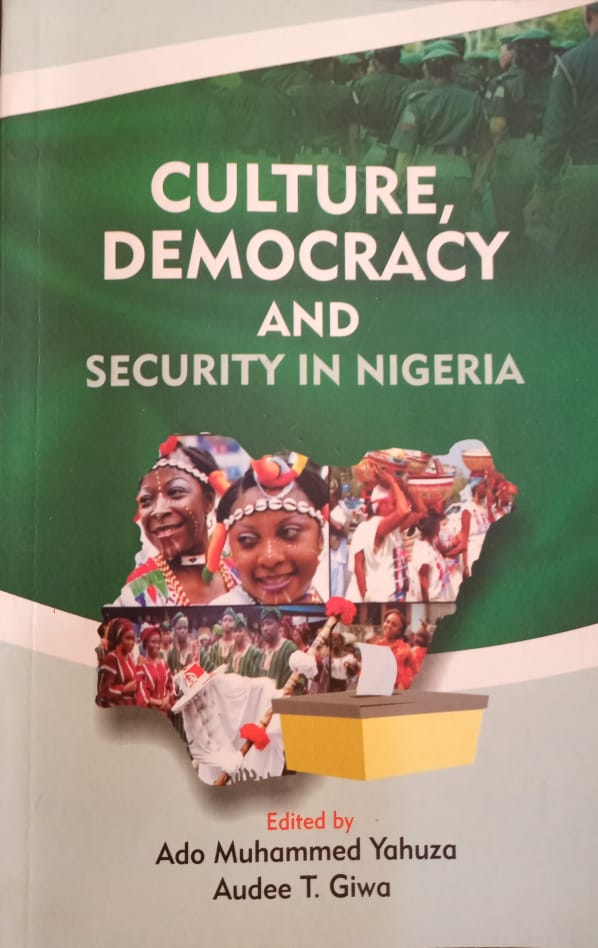
Book Title: Culture, Democracy and Security in Nigeria
Editors: Ado Muhammed Yahuza and Audee T. Giwa
Publisher: Kraft Books Limited, Ibadan.
Year: 2020
Pages: 89 pages
ISBN: 978-978-918-725-6

Insecurity is now an inescapable part of the lexicon when discussing the state of human affairs in Nigeria’s Fourth Republic. The exhilaration with which Nigerians received the democratic dawn has dampened. A salient feature of the hope of 1999 was that there would be better governance and representation from elected officials. This has not happened. Consequently, Nigerian democracy requires much more work to produce a country that progressively seeks to forthrightly tackle the onerous challenges confronting her.

Nigeria at the opening of the 2020s is a deeply polarized and insecure state divided along religious, ethnic and cultural lines and equally along agricultural occupational nomenclatures in the form of herders-farmers conflict. Similarly, the democratic culture is largely exclusionary with women who make up about half of the population as well as youths who are in the majority basically excluded.

Nigerian policy makers in the relevant strata of governance at the local, state and federal levels are, however, aware of the nation’s challenges, and some through several strategies are attempting to reflect on the nature of these challenges with a view to understanding how best policies and state action can be advanced to promote democracy by making it more inclusive and to provide security for citizens.

One such agency of government which has attempted to respond to the challenges the country faces is the National Institute for Cultural Orientation (NICO) an agency of the Federal Ministry of Information and Culture. NICO in publishing Culture, Democracy and Security in Nigeria edited by Ado Muhammed Yahuza, the executive secretary of NICO and Prof. Audee T. Giwa of Kaduna State University, has chosen to advance the role of culture and its relevance towards interrogating and addressing the challenges of Nigerian democracy and the vital question of how to tackle insecurity, which since the beginning of militant unrest in the Niger Delta has expanded to new dimensions as seen by the Boko Haram insurgency, farmers-herders conflict, separatist agitations and the now dangerously escalating phenomenon of kidnapping and hijacking by bandits and organized gangs in several parts of Nigeria.

Culture, Democracy and Security in Nigeria – a slim volume of six chapters by leading academic luminaries in the arts and humanities and three addresses presented by state officials is the result of an annual roundtable on cultural orientation that took place in Lokoja in Kogi state in 2019 on the theme of “Culture in the Consolidation of Nigeria’s Democracy: The Role of Women and Youths.”

In the address of Louis Eriomala, the then acting executive secretary of NICO, he advanced that for democracy to be viable, it needed to include and embed the participation of women and youth in positions of responsibility. Lai Mohammed, the minister of Information and Culture in his address noted that a lack of constructive engagement of the youths represented a clear danger to democracy and the electoral process. Rashida Bello, the wife of the executive governor of Kogi state in the third address lamented that the prevailing discrimination against women in leadership positions is “inimical to actual development… They are seen even by themselves as second class citizens in all spheres of life. These perspectives have to change and the time to begin the change is now” (20-21).

Chapters one to six are logical analysis of the thematic orientation of the book. The first chapter titled “Culture and the Consolidation of Nigeria’s Democracy: The Role of Women and Youths,” by Abdulmumeen Ahmed Okara, an architect and special adviser to the Kogi state governor highlights that democracy as a system hinges on the equal access of citizens irrespective of sex or age to freedom, justice and opportunities. Okara highlights that despite a history of discrimination, opportunities in the democratic space are available to women and youth. Professor Awam Menegbe in chapter two, “Culture and Democracy as Critical Factors in Sustainable Development in Nigeria,” contends that democratic culture as a way of life in Nigeria can be strengthened by Nigerians living up to their civic responsibilities.

In the third chapter, Prof. Patrick Ukase in “Towards a Culture of Peace and Non-violence during Elections in Nigeria: The Role of Women and Youths,” advances a more detailed analysis of the subject matter. Ukase a historian, provides a background of the cumulative elections in Nigeria since independence in 1960 and the various forms of violence that have regularly manifested with them. His highlights of the causes of electoral violence hinges on inter-elite and inter-ethnic contestations and employment of youths to violent ends by the political elite. The impact of violent elections is the disempowerment of citizens generally, and women specifically, whose apathetic view of politics arises from the violence therein. The way forward as advanced by Ukase is for youths to become “vanguards or agents of change and transformation” against political violence (46). For with less violence in politics women’s participation would be more assured and their latent roles of being agents of human development better harnessed.

Sunday Ogbu Igbaba’s chapter four titled “Not too Young to Run Act: An Appraisal,” provides analysis of Nigeria’s Age Reduction Act also known as the Not too Young to Run Act. The law reduces the age of qualification for electoral offices from the president of the federation downwards. Unfortunately other practical requirements such as high cost of purchase of forms by political parties still limit youth participation in electoral politics. In Chapter Five, Udeme Nana in “Re-Inventing Culture in the Quest for Sustainable Peace and National Security in Nigeria,” focuses on key aspects central to the theme of the book such as culture, peace and security. His submission calls for reinventing traditional cultures towards addressing the challenges of Nigeria’s modernity.

The final chapter, “Thinking outside the Box: New Strategies for Sustainable Peace and Security in Nigeria,” by Edet George Ubeng provides an exhaustive list of Nigeria’s security challenges from Boko Haram terrorism, kidnapping, farmers-herders clashes to cybercrime, ethnic clashes and armed robbery. His recommendation to these crises, some of which are caused by economic distress and unemployment of youths ranges from social engineering through education and enlightenment programmes to good governance by the state and effective policing by security agencies.

On the whole, Culture, Democracy and Security in Nigeria, though weak in some aspects such as in the length of some of the chapters and lack of in-depth analysis of the central themes is a worthy contribution to the development literature evolving towards tackling the ongoing challenges of Nigeria in the 2020s. Its pivotal contribution is to advance that for Nigeria to attain sustained human development there ought to be a re-evaluation of traditional cultures and current norms and mores with a view to utilizing the aspects relevant to a modernizing state. That doing so is crucial in evolving a democratic culture that values the integral participation of women and youths as developmental agents rather than as appendages.

Terhemba Wuam is a Professor with the Department of History, Kaduna State University, Kaduna, Nigeria. He is co-editor of Challenges and Prospects of Development in Twenty-First Nigeria (Bahiti and Dalila Publishers, 2019).
 NIGERIA REVIEW OF BOOKS