Terhemba Wuam
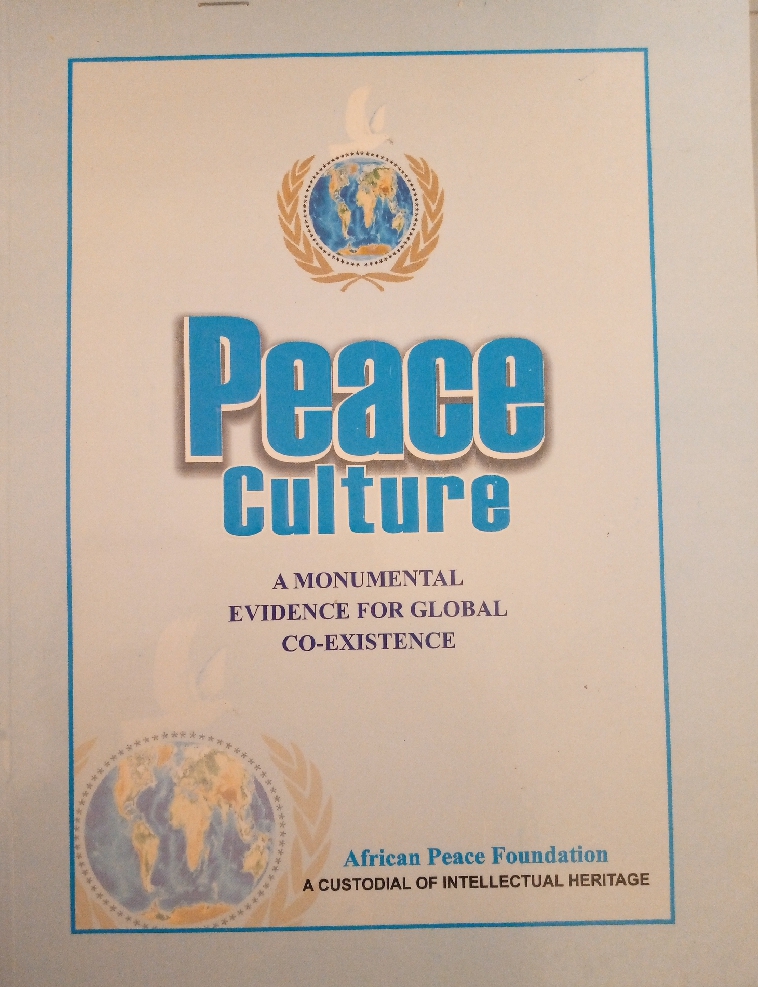
Book Title: Peace Culture: A Monumental Evidence for Global Co-Existence
Author: Ola Makinwa and Others
Publisher: African Peace Foundation, Abuja.
ISBN:: 978-978-086-908-3
Pages: l+436
Towards the end of the twentieth century, Africa was increasingly considered in the international community as a hopeless case for peace and the development of a peace culture. Decades of dictatorships and civil wars and the even more intractable conflict in the Democratic Republic of the Congo that had come to be dubbed the African world war persisted.
A litany of conflicts in Africa made peace take a back seat in the last decade of the twentieth century. From West Africa, crises in Liberia, Sierra Leone, Guinea, Mali, Niger and Cote d’Ivoire took various destructive and devastating dimensions. In North Africa, the Algerian Civil War would last from 1991 to 2002, the Sudanese civil war raged.
In East Africa and Central Africa the Somalia civil war will simmer and prolong. Djibouti was experiencing civil war and Ethiopia was in conflict as was Uganda, still under the throes of the Lord’s Resistance Army. The genocidal eruption in Rwanda will result to the massacre of over 800,000 Tutsi by the Hutu within a short space of three months. The Angolan civil war as well as conflict in Mozambique and other conflagrations on the continent rendered it as a basket case engulfed by conflict and devoid of peace and development.
Islands of hopes for Africa in the last decade of the twentieth century that highlighted that peace and a culture of peace was possible included the peaceful resolution of the Apartheid problem in South Africa and the emergence of Nelson Mandela as president of a racially integrated country. Equally, the swift manner in which Rwanda rose from its ashes to peace and reconciliation and rapid economic growth highlighted the possibilities of conflict resolution on the continent. The Rwandan case was indeed, reminiscent of the effective way in which Nigeria almost three decades earlier in the 1970s reunited the country after the civil war and facilitated the 3Rs of Rehabilitation, Reconstruction and Reintegration.
Africa was, however, not the only continent in crises, globally, prevailing conflict across the continents of the world prevented what could be termed a global peace culture to have dominance. The first Gulf War would open the last the decade of the twentieth century and involved a coalition of countries from America, Europe, Asia and Australia. There was war in Georgia that involved Russia, there was civil war in Colombia in South America. In the Balkans the disintegration of Yugoslavia led to a major combustion at the heart of Europe. In the Middle East, the Arab-Israeli conflict, and civil wars in Yemen and Afghanistan among others highlighted that conflicts, crises and wars despite their destruction constituted an unfortunate part of the human and global experience.
The coming of the new millennium and the twenty-first century, gave peace lovers and those who work for peace hope that despite the historical trajectory of global conflict, a new era would arise in which a culture of peace and resolution of conflicts and disagreements by other means would prevail to mitigate against destructive conflicts.
Two decades after, hower, the recent happening in the globe in the third decade of the twenty-first century indicate that peace cannot merely be wished for. That to have peace, the world must work for it.
For Nigeria, the challenge of entrenching a peace culture is one that has engrossed citizens, leaders and members of the civil society even before independence. The existence of a nation like Nigeria that is multicultural and multi-religious with diverse ethnic nationalities and with various estimates placing such groups at over 400 indicate the challenge that the nation and its leaders faced in constructing a society and culture that would not succumb to the vagaries of differences that act as agents of conflicts.
Since the civil war ended in Nigeria up to the outbreak of the Boko Haram insurgency in 2009, the years in-between were largely genteel. The horrors of the civil war made clear to citizens the dangers that outright conflict can have on a people. The outcomes of the civil war provided Nigerians with the vital lesson that peace was better and should be worked for. With that lesson, governments and Nigerian policies makers set out to promote policies of national unity and inclusiveness highlighted most prominently in the principle of federal character, which gave consideration to equity in the allocation of resources, employment and political values to all groups within the country.
The importance of peace which is the antithesis of conflict is such that in Nigeria, working for it is often not left only to the government. Just like conflict too is no longer the preserve of government through the proliferation of non-state actors whose goal is that of manifesting conflict and crises, there are also committed citizens and non-state actors in civil society whose objective and focus is to work for peace and nurture its enthronement through prevention, mitigation and resolution of conflicts in whatever forms they may arise within a nation or internationally. One such organization is the African Peace Foundation (APF).
The African Peace Foundation was established in Nigeria for the purpose of peace promotion and conflict resolution. Having seen the devastation that wars, conflicts and crises can wrought on a society and the global community through the increased level of human misery and suffering, dismemberment of communities and the stunting of economic prosperity as well as arrested development, the African Peace Foundation came into existence as an organization that would work for the achievement of peace within and beyond Nigeria.
The African Peace Foundation being aware of the horrors of the Nigerian civil war from 1967 to 1970 and the series of conflicts within Nigeria’s neighourhood of West Africa as well as within the broader borders of Africa had by the beginning of the twenty-first century and principally within the context of Nigeria’s Fourth Republic committed itself to series of initiatives aimed at peace promotion nationally and internationally.
A significant part of the APF contribution is intellectual. The African Peace Foundation intellectual contribution and advocacy is highlighted in the publication of Peace Culture: A Monumental Evidence for Global Co-existence.
Beyond the need to promote peace and strengthen peaceful co-existence globally, Peace Culture is also a timely response to a Nigeria in crises. The end of military rule in 1999 had released pent-up agitations and confrontations on various fronts in Nigeria. Within the first years of democratic revival in the country, existing fault-lines were splintering in all parts of the country, in the North, ethno-religious crises were witnessed with devastating impacts in Jos, Kaduna and Kano with reprisal attacks in Eastern Nigeria.
Ethnic conflagrations erupted in Taraba state between the Tiv and Jukun. In the Eastern Nigeria, the Aguleri-Umuleri conflict inflicted misery; and in the South-West the Ife-Modakeke crisis affected peace and stability. In the South-South environmental and economic conflict spurred an elevated level of militancy that would outlived the Obasanjo administration and would only be arrested during the administrations of President Umaru Musa Yar’adua and President Goodluck Jonathan.
Peace Culture by Prof. Ola Makinwa and his team, is thus published by APF in what is less than an ideally pristine and idyllic secured state. Since 2009, we now have the long-lasting Boko Haram insurgency, the rise of farmers-herders conflicts and banditry and other crises and challenges that have erupted with the coming of democracy and the Fourth Republic. These security challenges have all together conspired to make the attainment of a peace culture in Nigeria highly untenable and difficult.
***
Peace Culture: A Monumental Evidence for Global Co-existence written by Prof. Ola Makinwa and his editorial team was published by the African Peace Foundation, a custodial of intellectual heritage for pro-peace initiatives in Nigeria, Africa and the world. Peace Culture is introduced by two forewords, each written by two former presidents of Nigeria.
President Olusegun Obasanjo in the first foreword provides the measured assessment that Peace Culture “is a valuable contribution to the quest for a structured and well-grounded approach to engendering global peace, security, stability as well as global conflict prevention, conflict management, peace keeping, peace making and peace building” (xxxix).
In the second foreword, President Shehu Shagari recommends Peace Culture as a seminal publication with instructive insights on how to tackle both inter- and intra-conflict situations. He sees Peace Culture as “serious effort at correcting and educating, Local, National and International communities on how to handle issues in time of conflict and crises resolution” (xli).
Prof. Ola Makinwa and his team in writing Peace Culture provides readers with a handbook that explore the entire range of what constitute peace and how to manage both peace and conflict. In ten chapters knowledge is provided on the tenets of conflicts, and what it means to negotiate, prevent and resolve conflicts and how to provide security and build peaceful societies.
With peace as its main focus, the book emphasizes that “Peace is an attribute, a quality that exhibits freedom from disturbances, be it emotional or psychological. Peace entails being in a state of friendship or harmony” (64).
The book further contends that: “Peace in its natural self is about love, love is about co-existence, co-existence is about governance, governance is about politics and politics is about democracy… Without peace, there can be no democracy, no matter from what perspective one views politics or that politics is played, without peace, it will always result into conflict. Therefore democracy is peace and peace is democracy. He who must play politics in a democratic system must imbibe the culture of peace to avoid political and electoral unrest or violence” (65).
This position of the book that politicians and Nigerians “must imbibe the culture of peace to avoid political and electoral unrest or violence” (65) Is central to understanding the outbreak of conflict and their escalation in Nigeria and the rest of the Africa. The comprehension of this point is crucial to the maintaining of peace. How such peace evolves and becomes sustained in a society and the mechanism by which that is possible can then be described as the coming into existence of a peace culture.
Evolving a peace culture involves the individual, his community, state and nation and the international communities. The desire to promote global peace has culminated in the collective establishment of the United Nations whose chief aim is to maintain international peace and security through saving “succeeding generations from the scourge of war” (55). Thus while internationally the world through the United Nations seeks to eliminate war and its associated misery, within the Nigerian national context the abiding objective is to reduce the fear of conflict and insecurity and allow for society to thrive through the full expressions of the human potential in an atmosphere of peace and total freedoms. Where citizens will work together in mutual co-existence in a co-dependent world.
Having defined and conceptualized what is meant by peace and peace culture, in chapter one, the authors in chapter two undertake to evaluate what is meant by conflict, how it emerges, the mechanisms by which this happens and its overall dynamics. The term conflict is defined as “a collision of moving bodies. It refers to a sharp disagreement or collision in interest or ideas and emphasizes the process rather than the end. Conflict is a general word for any contest; struggle or quarrel, stress, physical or hand-to-hand combats” (85).
By this definition the mechanisms through which conflict can arise and combusts relates to the types of conflict. In this sense the nature of the conflict has the potential to highlight its scale. This is because intrapersonal conflict, interpersonal conflict, intragroup conflict, inter-ethnic conflict, inter-religious conflict, political conflict or international conflicts all have different scales of causes, trajectory and significance. In these conflicts, the authors show that there are different architects with different roles in either escalating or deescalating the different types of conflicts.
Because of the fact that each type of conflict must involve actors or architects, understanding the motives behind their agitations and actions is usually the right step towards conflict prevention and mitigation. This valuable lesson from Peace Culture is one that government and traditional authorities should adhere to. The state must therefore “invest time, money and efforts to notice the signals” (126) in order to take curtailing and pre-emptive measures.
Chapter three of Peace Culture tackles among others an issue that only became significant in Nigeria’s national lexicon in the years after 2009. This is the matter of terrorism as a tactic used by Boko Haram insurgents. Broadly, however, the chapter addresses how terrorist conflict and wars can be preempted and diffused by governments at all level, particularly in Nigeria.
In the evolving trajectory of security challenges and discourse in Nigeria, chapter three is of vital importance. Its treatment of the subject of terrorism and war in global conflicts yields important nuggets for understanding the rationale of terrorism and what terrorists seeks to achieve in their targets of civilians and innocents. As the book states “every human being is a potential target – children, adults, men and women irrespective of age, race or creed. Terrorism makes all human beings potential victims” (131).
Terrorism is in every sense as Prof. Ola Makinwa and his team notes “an immoral form of violence, without domestic or international legal basis and must be widely condemned” (131). To address and prevent terrorist acts and wars, the book outlines that conflict prevention as a goal of national security should be given optimum focus and appropriate peace and security strategies implemented by government and citizens with a view to preventing and diffusing conflict outbreaks.
Another significant intellectual dimension addressed by this book is the interrelated nature of the world. In such an interrelated world, diplomatic relations are essential. This is because diplomacy which has its roots in the ancient world since the emergence of states is the process by which nations relate with one another both in times of peace and war.
Diplomacy within a nation and between a nation and its attributes of relationship building is the subject of chapter four, which emphasized that listening and paying attention to others needs and interest at the level of international relations is a crucial aspect of international peace building. This understanding is equally reiterated in chapter five, where the focus is on conflict mediators and the need for them to understand what conflict entails and its impact on diverse actors, and the relevant approaches to be adopted to de-escalate conflict and bring about reconciliation.
Chapter six on “Solution: Short and Long Terms” is a pivotal chapter of immense value to the urgent need to achieve peace and enshrine a culture of peace nationally and globally. The chapter is a discourse on what the solutions are for preventing conflict and achieving peace both in the short and long term. Solutions to conflict in the long term come from the general society understanding and practicing tolerance at the levels of religion, politics and economy.
Critically, sustaining long term peace and stability in Nigeria as the authors show will involve government and its agencies providing good governance for Nigerians citizens. According to the authors, good governance “assures that corruption is minimized, the views of minorities are taken into account and that the voices of the most vulnerable in society are heard in decision-making. It is also responsive to the present and future needs of society” (238).
The role of religious and community leaders, non-governmental organisations and international organisations is also important in facilitating good governance through interfacing with government and executing programmes that improve the condition of the masses.
Chapters seven to nine of this important handbook published by the African Peace Foundation essentially provides a how-to guide in the actual processes of peacemaking, mediation and resolution. The attention being in the provision of security, peace maintenance and empowerment. These three chapters emphasized that for peace to take root in theatres of conflicts, there must be peacemaking. And that as such political institutions i.e. the governments at both state and federal levels ought to develop and articulate agendas for peace. Such peace agendas, including mediation strategies, can be tailored to suit the peculiar conflict being experienced and equally focused on the different conflict stages. The implementation can then be by both state and national governments as well as by the United Nations and its agencies.
Even though Prof. Ola Makinwa and the African Peace Foundation have noted that not all conflict is negative; they have also clearly highlighted that the negative consequences of conflict far exceeds whatever benefit it may have on communities and nations.
In chapter ten, they proceed to show the human toll of displacement experienced by societies affected by violent conflict from historical times to the present. This is in the nature of the refugee problem and that of internally displaced persons and the international conventions that regulate their treatment by national and international parties. In data they provide, they show how millions have been rendered homeless due to conflict.
This book is a welcome publication. It is relevant and timely in a Nigeria that a lot has happened in the past three decades with respect to the deterioration of the peace culture that took root and flourished after the Nigerian Civil War. Increasingly, the challenges of conflict now arise from different parts of the country, the most significant of these being insurgency in the North-East, and incidences of farmers-herders conflict across the country and the upsurge of banditry in North-West and North-Central Nigeria. All these have created a security dynamic that is threatening the peace and stability of the nation. Amidst these challenges the states and the federal government while exploring and implementing different measures face asymmetrical threats that calls on them to respond with superior knowledge.
Some key aspects of the level of intellectual guidance required can be found in Peace Culture. The volume is insightful in its evaluation of what constitutes peace and how peace can be attained and sustained. Among others its evaluation of intellectual and psychological dimensions of conflict makes the book a necessary handbook and manual for the security sector and Nigeria’s political leadership. This is even as the lessons of Peace Culture: A Monumental Evidence for Global Co-Existence transcend national boundaries.
Terhemba Wuam is a Professor with the Department of History, Kaduna State University, Kaduna, Nigeria. He is co-editor of Challenges and Prospects of Development in Twenty-First Nigeria (Bahiti and Dalila Publishers, 2019).
 NIGERIA REVIEW OF BOOKS