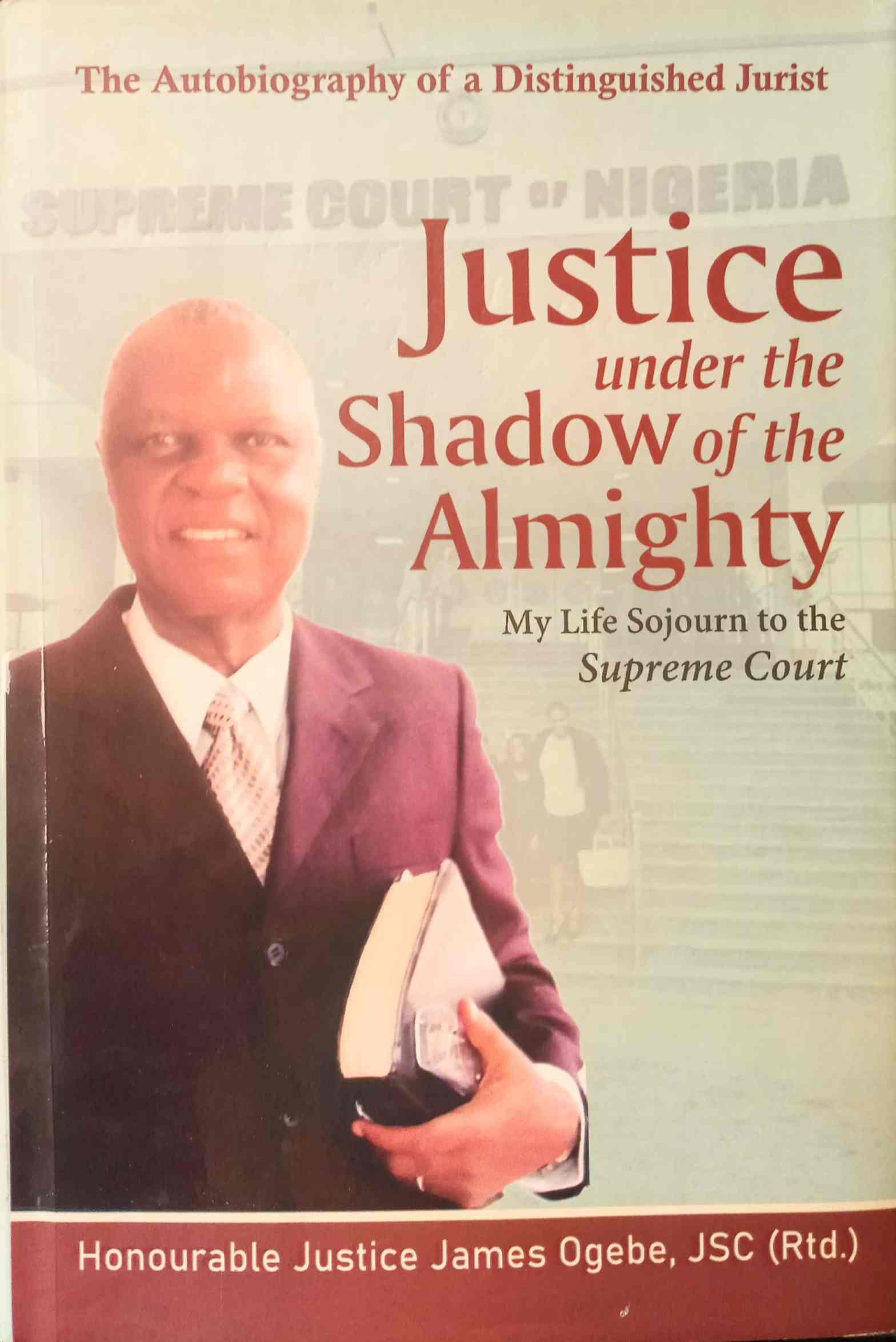
Book Title: Justice under the Shadow of the Almighty: My Life Sojourn to the Supreme Court
Author: Honourable Justice James Ogebe, JSC, Rtd.
Publisher: NiU Nation Publishers, Ile-Ife.
ISBN: 979-8-6373-3107-9
Pages: xxvi+306

Terhemba Wuam
In 2020, Justice James Ogebe, JSC published his autobiography. If a reader were taking up the book for legal insight, perhaps as to while his judgements annulled the impeachments of Governor Rashidi Adewolu Ladoja of Oyo state and Governor Peter Obi of Anambra state, his prefatory remarks clearly dissuaded that the book is more personal than legal. However, despite this caveat by the eminent jurist, the book is as revealing for its legal insights into these decisions as also to the nature of his relation to the Almighty God.
The book came ten years after the retirement of Justice James Ogebe from the Supreme Court of Nigeria. Published at his attainment of 80 years of age, the period since retirement had given him ample time to reflect and document his journey from birth to the highest court in the land.
Justice Ogebe’s origins emanates from the Idoma village of Igwumale (Igumale) in Ado local government area of Benue state. He was born in a world quite different from that of his ancestors. In 1940, the year of his birth, Idomaland under British colonial rule was undergoing incipient modernization with the arrival of western education and schools established by both the colonial authorities and the Christian missionaries. In Igwumale, the first missionaries arrived in 1924 barely a generation before his birth. These were the Methodist, who established a “Primary School which was the first such institution in Idoma land” (5).
It would be his good fortune to attend the Methodist School, which was the only school in the area as would generations of the earliest western educated elite in Idomaland such as Chief Onazi Ameh Onazi and Dr. Edwin Ogebe Ogbu. The later would have an illustrious public career serving as federal permanent secretary and Nigeria’s permanent representative to the United Nations.
The trajectory from the Methodist primary school, where he enrolled when he was six years old in 1946, would see him proceed to the Benue Middle School, Katsina-Ala in 1954 and to Government College, Keffi in 1956, before proceeding to Ahmadu Bello University to read law and graduating in 1967.
It is significant to note that Justice Ogebe by his admission was converted to Christianity in 1957 while at Government College, Keffi. He writes that:
“I received the Lord Jesus as my Savior on the 13th of February 1957 and became active in the Fellowship of Christian Students (FCS) throughout my remaining six (6) years in Keffi. The Rev. Virgil Kleinsasser, an S.I.M. missionary, discipled and helped us to grow in our knowledge of Christ. We kept in touch until his transition to glory in 2017. He got to meet my children and grandchildren in America” (13).
At Ahmadu Bello University, Justice Ogebe was be active in the Fellowship of Christian Students and the campus chapel. As the account of his life in this autobiography unfolds, the nature of the influence of his Christian faith and his relation with his creator becomes clearly manifest. Another point of importance to him was that:
“I was on Government Scholarship from primary standard two up to the Law School. My parents could not have afforded my education, but God in His infinite care and provision ensured that the government bore all my educational expenses. As a result of that, I was committed to serving God and my nation: Nigeria” (16).
Justice Ogebe and his fellow law graduates at Ahmadu Bello University and others who passed out at the Nigerian Law School in 1968, as well as other graduates in different fields of knowledge were clearly Nigeria’s pioneering educated elite in the various fields, particularly those from Northern Nigeria. The 1960s class would become pathfinders in the legal field and go on to dominate the legal and judicial firmament of the country.
As the autobiography recounts, the 1968 set would provide Nigeria with several Supreme Court justices and Chief Justices of Nigeria, High Court Judges, Solicitors Generals, Attorney Generals, Chief Registrars, Senior Advocates of Nigeria among several others. In the 1960s and 1970s there were more positions available than the universities could turn out qualified graduate to fill. When Justice Ogebe reported for work in Jos, the capital of the newly created Benue-Plateau state in 1968 after finishing law school, he arrived at the state Ministry of Justice that had only three law officers. In Jos he would serve alongside Morgan Ogbole, the solicitor-general, who was also the first lawyer from not only Idomaland, but also Benue state.
His work as a pupil state counsel in the Benue-Plateau state judiciary would be quite fulfilling due to the opportunities of the day where he was “privileged to be in and out of the Supreme Court many times. That exposed me to the higher courts in those days” (21). He was also “saddled with the responsibility of training the pupil state counsel junior to me in the ministry; although I was still a pupil myself” (22). A task that he was happy to deliver on.
In 1974, a new path would open for Justice James Ogebe, from his duties of prosecution in the Justice ministry, he was appointed a Senior Magistrate and Acting Chief Registrar. With respect to this departure from his earlier work, he noted that:
“It was unfamiliar ground for me… I was simply given the keys of the office by the Senior Judge, the Honorable Justice D.L. Bate, who wished me good luck without any hint on what was expected of me. I entered the office and immediately knelt and prayed to God for guidance in the performance of my duty. I was not given any handover notes. I knew next to nothing of how the office was to be operated” (27).
From that appointment and with the creation of Benue State in 1976, he would be appointed to the bench as High Court judge of Benue State on 14 July 1976 alongside Justice Sylvester Onu, making them the first high court judges of the new Benue State. His appointment unlike that of Onu which was in acting capacity was made substantive two years after in September of 1978. He would also later oversee the Benue State judiciary as Acting Chief Judge in 1985, but instead of confirmation as the Chief Judge he was passed over. He, however, remained in the state judiciary until his appointment as Justice of the Court of Appeal in December 1991. His first posting would be at the Benin Division, where he assumed for duty in January of 1992.
As a Justice of the Appeal Court, he served at the Appeal Court branches in Benin, Kaduna, Jos, Port Harcourt, Lagos, Enugu and Ibadan. Some of the cases he was involved in from 1999 when the Fourth Republic began and democracy returned to Nigeria involved electoral and political matters. The decision of the Appeal Court in Ibadan where he alongside other judges on the court decided the case was of great importance to the Fourth Republic. It was a decision of fundamental importance in the quest to limit federal executive interference and legislative overreach.
Justice Ogebe and others decision to annul and dismiss the impeachment of Governor Rashidi Ladoja as illegal was widely acclaimed for its merit of remedying a clear case of illegal political action. According to Justice Ogebe their action was of huge significance to Nigerian democracy. Its implication would also become clear in other cases as:
“That judgement set the tone for the restoration of Governor Peter Obi of Anambra State by my division at the court of appeal in Enugu and Governor Dariye of Plateau State who was impeached wrongly by their Houses of Assembly” (54).
In 2008 Justice Ogebe was appointed to the Supreme Court of Nigeria, the highest court in the land. He was 68 years old when the appointment was made and would serve for two years before retiring at the retirement age of 70 for Nigeria’s Supreme Court judges. This followed sixteen years of service at the Court of Appeal for sixteen years. It was also 32 years since his first appointment as a High Court judge in the Benue state judiciary.
Justice under the Shadow of the Almighty: My Life Sojourn to the Supreme Court is both about the judicial life of the subject and also about his family life and his faith as a Christian. The account of his spiritual life and the support that Dr. Mary Ogebe, his wife, provided him with after six decades of marriage was “a step of faith” (76) that enriched their union of six decades.
The tragedy of losing a daughter, Enene Alheri in 1995, through a motor accident, saddened the family, but they were consoled that she is now their ambassador in heaven. His commitment to God is also shown in his service to the church, widows and the less privileged in society.
The book is enriched with pictures, letters and other official documentations beginning from the 1950s and to the author’s days in the Supreme Court and beyond. The book is indeed an insight into the legal career of one of Nigeria’s eminent and pioneering jurist, whose judicial impact on Nigeria’s Fourth Republic contributed to bringing sanity to the electoral process and curtailing the excesses of the political class. His life of service and probity stands out as a lesson to not only those in the legal profession but to all Nigerians.
Terhemba Wuam is a Professor with the Department of History, Kaduna State University, Kaduna, Nigeria. He is co-editor of Challenges and Prospects of Development in Twenty-First Century Nigeria (Bahiti and Dalila Publishers, 2019).
 NIGERIA REVIEW OF BOOKS