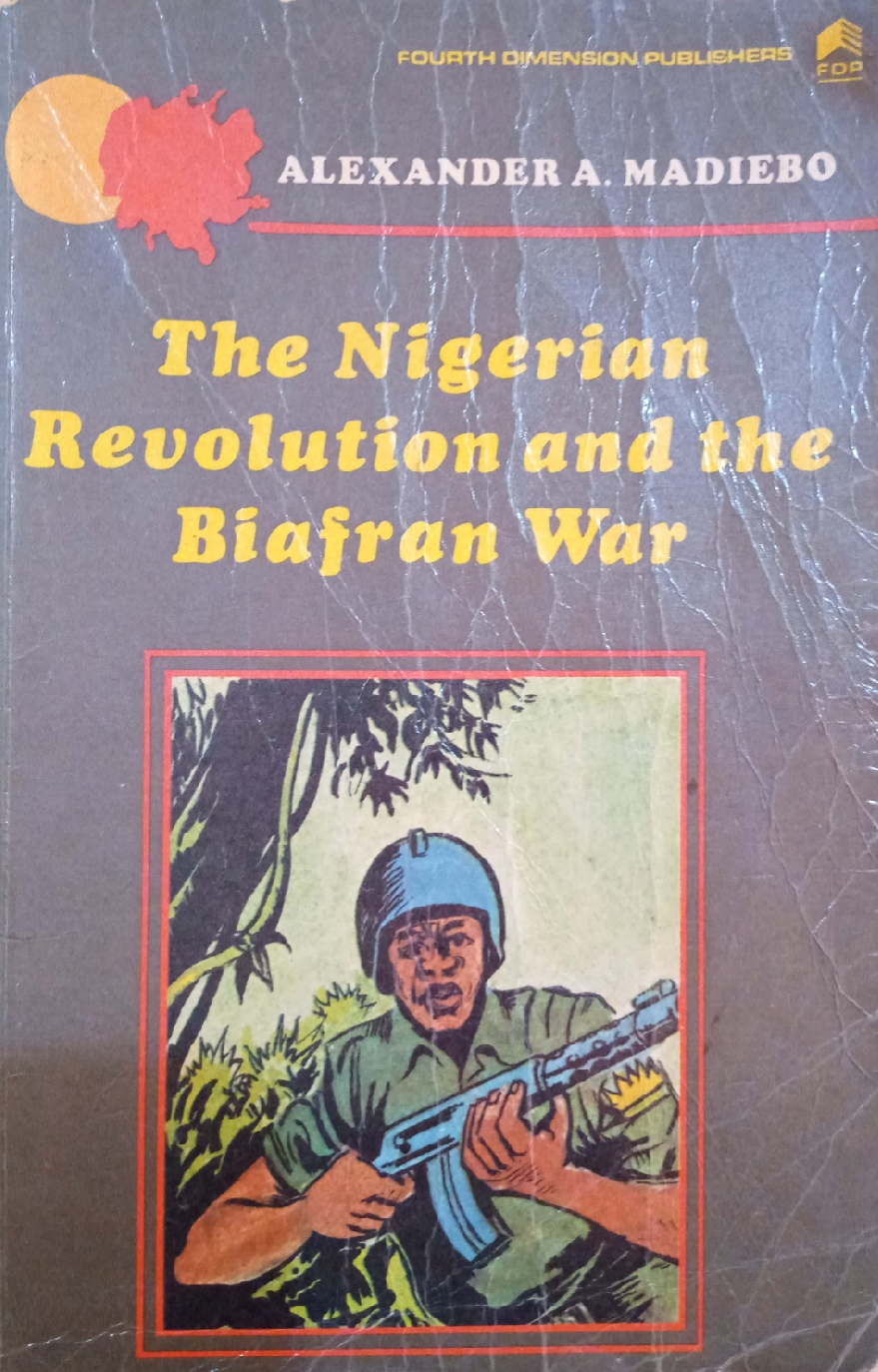
Author: Alexander A. Madiebo
Book Title: The Nigerian Revolution and the Biafran Civil War.
Publisher: Fourth Dimension Publishing Co. Ltd., Enugu, 1980.
ISBN: 978-156117-3.
Pages xii+410.

Terhemba Wuam
Alexander A. Madiebo’s career as a soldier lasted for seventeen years. He joined the Nigerian army and served the Nigerian federation for 14 years. In the Nigerian army he rose to the rank of a lieutenant-colonel and saw service in Cameroun and in the Congo under the auspices of the United Nations.
The last three years of his military career saw him in the Biafran army. First, and very briefly as the commander of the 51 Brigade of the Biafran army for a limited two months period and then as the Biafran army chief who oversaw the defence of Biafran secession in Africa’s first industrial scale and modern war.
Major-General Madiebo, as he was in the Biafran army, has now faded away as they say of old soldiers. He was born on 29 April 1932, and joined the army in colonial Nigeria when he was 22 years of age in 1954. He assumed command as general office commanding the Biafran army at 35 and would retire following the end of the Nigerian Civil War in 1970 at 38.
What General Alexander Madiebo and his contemporaries did before they attained middle age will define much of Nigeria’s history that was to follow. His death on 3 June 2022 at the ripe age of 90 will come 52 years after the end of the civil war.
When I heard of his death, I searched my shelf for The Nigerian Revolution and the Biafran War, his book on the civil war, published in 1980, ten years after the war.
The Nigerian Revolution and the Biafran War is a work of history, a personal account of the author documenting history in motion as it occurred. It is a history of how Nigeria moved from a mere geographical expression to a country forged in steel and blood. With sacrifices made on each side of the conflict for the idea of a Nigerian fatherland composed of a multitude of ethnic nationalities co-existing together in a federal state. In the tolls and horrors of the war that couldn’t have been imagined, Nigeria emerged with lost innocence.
In The Nigerian Revolution and the Biafran War, Madiebo presents readers with the background of the unfolding events that led to the outbreak of the civil war in 1967. The impact of the two coups of 1966, that of 15 July and the counter of 29 July, both of which in their execution fractured the hitherto existing ethnic and political faultlines.
On the road to war were: the initial failings of Major-General Johnson Aguiyi-Ironsi and General Yakubu Gowon regimes lack of decisive nation-building actions. Their limitations in addressing of grievances and curtailing the outbreak of widespread violence, as well as Chukwuemeka Odumegwu Ojukwu’s inflexibility all created the point of no-return that led to Nigeria’s 30 months brothers’ war in Eastern Nigeria.
The trajectory of the tragic war is Madiebo’s subject and it is well-to by him, the heroism of the combatants, the innovations and will to keep on in the face of overwhelming odds and the human suffering the civil population endured are vividly portrayed.
Although told from the Eastern Nigerian viewpoint, the book offers perspective in considering the unmitigated errors on both sides, which could have been avoided, but were not, and which, as a consequence created the tragedy of the Nigerian Civil War.
The Nigerian Revolution and the Biafran War, published 42 years ago, still offers vivid lessons. The narrative and descriptive powers of Madiebo still astounds. It is a work that should be read by all Nigerians. In it, the understanding and accommodating national spirit of the old soldier lives on.
Terhemba Wuam is a Professor with the Department of History, Kaduna State University, Kaduna, Nigeria. He is co-editor of Challenges and Prospects of Development in Twenty-First Century Nigeria (Bahiti and Dalila Publishers, 2019).
 NIGERIA REVIEW OF BOOKS