Terhemba Wuam
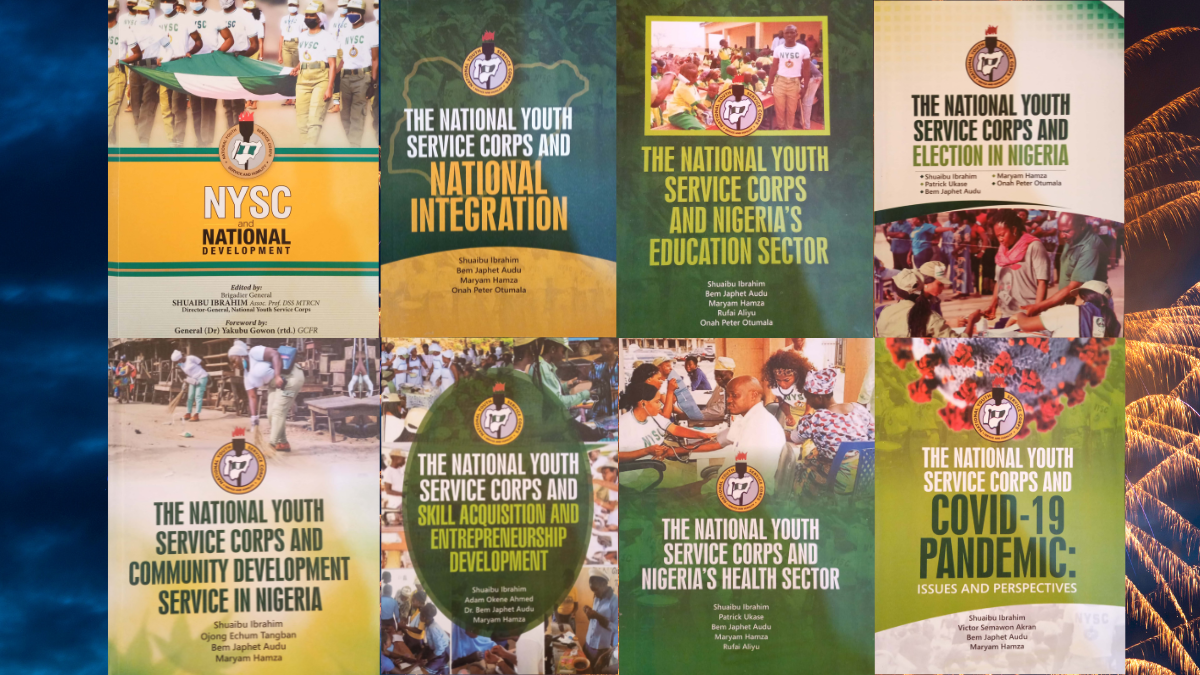
- Shuaibu Ibrahim (ed.), NYSC and National Development, Published for the National Youth Service Corps by Manhasdu Printing Company Ltd., Lafia, 2021. ISBN: 978-978-989-614-1. Pages xviii+681.
- Shuaibu Ibrahim, Bem Japhet Audu, Maryam Hamza and Onah Peter Otumala (eds.), The National Youth Service Corps and National Integration,Pyla-Mak Press and Publishers Limited, Kaduna, 2021. ISBN: 978-978-58821-4-8. Pages xiv+254.
- Shuaibu Ibrahim, Bem Japhet Audu, Maryam Hamza, Rufai Aliyu and Onah Peter Otumala (eds.), The National Youth Service Corps and Nigeria’s Education Sector,Pyla-Mak Press and Publishers Limited, Kaduna, 2021. ISBN: 978-978-58821-1-7. Pages xiv+315.
- Shuaibu Ibrahim, Patrick Ukase, Bem Japhet Audu, Maryam Hamza and Onah Peter Otumala (eds.), The National Youth Service Corps and Election in Nigeria,Pyla-Mak Press and Publishers Limited, Kaduna, 2021. ISBN: 978-978-58821-2-4. Pages xiv+213.
- Shuaibu Ibrahim, Ojong Echum Tangban, Bem Japhet Audu and Maryam Hamza (eds.), The National Youth Service Corps and Community Development in Nigeria,Pyla-Mak Press and Publishers Limited, Kaduna, 2021. ISBN: 978-978-58821-0-0. Pages xiv+343.
- Shuaibu Ibrahim, Adam Okene Ahmed, Bem Japhet Audu and Maryam Hamza, (eds.), The National Youth Service Corps and Skill Acquisition and Entrepreneurship Development,Pyla-Mak Press and Publishers Limited, Kaduna, 2021. ISBN: 978-978-58566-8-2. Pages xvi+341.
- Shuaibu Ibrahim, Patrick Ukase, Bem Japhet Audu, Maryam Hamza, Rufai Aliyu (eds.), The National Youth Service Corps and Nigeria’s Health Sector,Pyla-Mak Press and Publishers Limited, Kaduna, 2021. ISBN: 978-978-58821-3-1. Pages xiv+350.
- Shuaibu Ibrahim, Victor Semawon Akran, Bem Japhet Audu and Maryam Hamza (eds.), The National Youth Service Corps and COVID-19 Pandemic: Issues and Perspectives,Pyla-Mak Press and Publishers Limited, Kaduna, 2021. ISBN: 978-978-58566-9-9. Pages xiv+308.
The National Youth Service Corps (NYSC) is perhaps the most hallowed and respected of Nigeria’s institutions. Established in 1973it has come to represent a rite of passage of for all graduates under the age of 30. Service apart from the reluctance expressed by the very first batch of the NYSC, when it was a new and novel scheme is profoundly looked forward to by Nigerian tertiary graduates.
Initially it embraced those possessing degrees, higher national diplomas (HND) and the national certificate of education. At present, however, those possessing the national certificate of education (NCE) are excluded from national service.
In 2020 eight books on the NYSC were published. This review is about these eight books.
Each of these books deserves a separate and in-depth review. However, presenting them all in one snapshot achieves the goal of highlighting the major intellectual contributions the editors and authors were able to achieve in documenting the history and achievements of the NYSC in Nigeria. The achievement of the publications also highlights what Nigerian academia is capable of with adequate and timely funding of research endeavours.
The NYSC and National Development is edited by Major-Gen. Shuaibu Ibrahim. Gen. Ibrahim who holds a doctorate in History. He is also an Associate Professor at the Nigerian Defence Academy and at the time of publication was the Director-General of the National Youth Service Corps (NYSC). The foreword is written by Gen. Yakubu Gowon, the former military head of state who set up the National Youth Service Corps. The volume is a compendium of the activities of NYSC since inception and the contributions of the corps to national development.
The opening pages outlines the NYSC mission as an institution as: “To mibilise and groom graduate youths for the promotion of national unity, sustainable development, self-reliance and prepare them for the challenges of leadership” (v).
The vision of the NYSC is highlighted as “To develop a Scheme that is dynamic enough to meet new challenges and become the leading light of youth organisations in Africa” (v).
In the foreword, Gen. Yakubu Gowon whose government established the NYSC in 1973 notes that the volume “…throws light on all facets of the scheme and critically examines the historical perspectives, philosophy behind its foundation and contributes to nation-building and youth empowerment in order to help with policy formulation and improvement” (vi).
A large volume of this nature involved the committed work of several individuals. The 681 pages in addition to the prefatory text attests to the quantum of work that went into its publication. The book details the objectives of nation-building and youth mobilization for national development as the key objective for which the scheme was established in 1973 the background of the just concluded Nigerian Civil War which had ended in 1970.
The book chronicles the initial reluctance of graduates who protested against the scheme because:
“Primarily, the students who were to drive the wheel of a renewed Nigeria were unsure of their safety in the states considered far-flung, given the fact that the establishment of the corps was coming on the heels of a bloody civil war that just ended, which further created fears in the minds of the students and their parents” (xvii).
Since then, however, participation in the NYSC has become a rite of passage for Nigerian graduates. With the scheme over the years achieving its objectives of fostering greater integration and understanding among ethnicities and states in the country.
The book’s 20 chapters are quite enriching and revealing of the vision and mission of the NYSC in operation. The outlook of Nigerians to the scheme has also been positive. As the book shows, among both ex- and serving corps members the assessment is that the NYSC as an institution has met its objective of national integration. Indeed, a then 2019 serving corps member Oluboba Ayodeji Ebenezer assessment of the NYSC is illustrative of its impact. He noted the NYSC achievements as:
“The NYSC has been an educating and impacting scheme. So far, it has put in place systems and programmes to build Nigerian youths inside and outside; not just to be a benefit to the country alone, but also unto themselves. So far so good it has been a wonderful Scheme, although it can be better” (589).
The emphasis of this volume in the series is on national integration. This is the cardinal reason for which the NYSC was established following the end of the Nigerian Civil War. Its emergence as a tool for national unity whereby young graduates are sent to states other than theirs was meant to introduce Nigerian graduates to the peoples and cultures of their diverse country and in so doing foster understanding and national integration.
The volume is a discourse of the challenges and prospects of national integration in Nigeria and the sterling role that the NYSC as an institution has played in facilitating greater integration, perhaps, more so than any other national organization in the country.
As observed by James Aboi in a chapter entitled “National Integration in Nigeria: The Way Forward,” “This selfless spirit geared towards contributing to the development of communities where NYSC Corps Members are domiciled does not only promote regional growth it fosters national integration because it brings out the best in individuals at regions that have no claims to their origins or genealogy” (204).
The volume is a vital intellectual addition to the subject of national integration in Nigeria, as one of the contributors, Philibus Audu Nwamagyi notes in chapter seven, “This inter-ethnic and socio-cultural mingling enables them to learn the cultures of the indigenous people in their places of postings” (108).
The chapters in The National Youth Service Corps and Nigeria’s Education Sector appraised the education sector and its evolution in Nigeria with particular attention to primary and secondary education. It highlights the contributions of the NYSC to education in the country at these levels. Most Nigerians, according to the contributors are introduced to the direct work of corps members when the NYSC posts them to schools in both urban and rural communities.
As Ladi Charles Chiwar in her chapter “NYSC and Knowledge Production in Nigeria,” asserts that: “Most corps members posted to rural schools are zealous and dedicated, more aware of new means and ways of imparting knowledge on the students” (276).
Over the years, the contributions that the NYSC have made to primary, secondary and mass education are well documented in this particular volume. The book is also enriched by the discourses on the history and development trajectory as well as the politics of school ownership in Nigeria.
Nigeria’s Fourth Republic remains the country’s longest era of political stability. The NYSC as an institution and corps members have been part of this process of building and sustaining an enduring democratic era. This is the subject of this volume. The various contributors have documented for posterity the role of the NYSC in Nigerian elections with the NYSC officially partnering with INEC to provide ad-hoc staff for elections.
The NYSC role in Nigeria’s democracy has also come at a heavy price. In the 2011 General Elections 11 corps members died. Because of this unfortunate occurrence, Rabiatu Ibrahim Abdullahi in chapter eight entitled “The NYSC and Elections in Nigeria: An Examination of the Challenges of Corps Members During the Conduct of Elections,” laments the deaths of corps members in the 2011 elections acted in some measure to dampen corps members participation because it “played a significant role in discouraging corps members from officiating in elections” (125).
While, this is an important book, its major limitation is the absence of a specific chapter on the 2011 episode in which the corps members died. That there is none should have been an avoidable lacuna.
The aspect of community development service (CDS) is a longstanding core component of the NYSC. As the authors show, all corps members must perform community development service in their area of primary assignment in designated groups.
These groups are officially sixteen. However, corps members can in addition to performing the group CDS, also engage in personal community development efforts. Corps members on CDS offer legal services, perform sports, carryout environmental protection and sanitation, provide educational services and are involved in creating road safety awareness. They also participate in disaster management and implement medical and health services outreach. There are also charity and gender groups and anticorruption groups as well as reproductive health and HIV/AIDS and sexual awareness community awareness service groups.
The impact of all these according to Olutayo Ajibade and Emilia Tanko in chapter fifteen“Trends, Continuity and Change in the Nigeria’s National Youth Service Scheme,” is that it “has led to several identifiable achievements of the Scheme overtime” (319) across the country, wherever youths are sent to serve.
The volume on skills acquisition and entrepreneurship development is one that addresses a topic that the NYSC has gradually evolved to accommodate. In the early years of the NYSC, when jobs were more plentiful than there were graduates to fill them, attention was not paid to skills and entrepreneurship development.
The changing times as the various contributors note is what has led to the institutional introduction of the Skills Acquisition and Entrepreneurship Development (SAED) Programme as a directotrate of the NYSC. It came into existence in 2012. There is also the NYSC War Against Poverty (WAP) programme.
The chapters in the book focus on the increasing role the NYSC is playing in the human capacity and leadership development as well as in equipping corps members with entrepreneurship knowledge and skills to thrive in the private sector.
The role of the partnerships between NYSC and other stakeholders especially, the private sector and the financial sector are systematically developed and analysed by the authors. Their analysis emphasized that incorporating SAED into the NYSC regimen contributes to the growth of self-sustainability for corps members when they pass out into the greater Nigerian society. SAED enables them to take the initiative in agriculture and businesses and to be innovative after the service year.
In chapter five“National Youth Service Corps (NYSC) and the War Against Poverty (WAP) Agro-Entrepreneurs Empowerment Programme in Nigeria, 2009-2020” by Ozinna Tochukwu Ntukogu, he observes that preparing corps members for life after service is yielding positive results. He notes that “…one of the schemes through which Nigeria has combated poverty in the country is the National Youth Service Corps (NYSC)… One of the major ways through which the scheme has been empowering youths is through the NYSC War Against Poverty (WAP) Programme” (91-92).
Two out of the eight published books are concerned with the health sector. One is focused on the NYSC contributions to the Nigerian health sector and the other is on the COVID-19 pandemic.
The National Youth Service Corps and Nigeria’s Health Sector is made up of studies by the conributors from the perspective of how corps members who are graduates of medicine, health-related courses and pharmaceutical studies have contributed in their various capacities as medical doctors and other health professionals in providing medical and health services and health education to Nigerians across the country while serving the fatherland.
The NYSC has made contributions to the physical, mental, social and emotional well-being of Nigerians in urban and rural settings with particular emphasis on the latter through special initiatives for rural dwellers. It has also provided education towards fighting drug abuse among the youthful population in the country.
The impact of NYSC graduate doctors is clearly shown by Usman Abubakar Lamido in his chapter in the book entitled “The NYSC and Health for Rural Dwellers.” Like others he points out the significant contributions of the scheme thus:
“The Health Initiative for rural dwellers has impacted the rural communities positively… specialists in the medical field (majorly corps members) including medical doctors, nurses, pharmacists were posted to these various communities and they have been very helpful to health awareness creation in these rural communities and have complemented the efforts of the already stationed medical personnel that are on ground in these communities” (189).
The coronavirus disease (COVID-19) started in the Chinese city of Wuhan in late 2019. It quickly crossed borders and swept through the world, and by March of 2020 the World Health Organisation declared it a pandemic.
The global response to the threat of COVID-19 to humanity attest to the high heights that human civilization has attained in its ability to recognize clear dangers to its survival and on the basis of clear science articulate logical pathways for arriving at practical and effective solutions.
In the wake of the conspiracy theories that the COVID-19 pandemic spawned, men of goodwill, above such pettiness shouldered on and through the miracle of science and modern medicine were able to instruct on the correct protocols and to produce vaccines in record time. The frontiers of medical science were extended. And hopefully, the new knowledge being develop will in time yield new discoveries and provide solutions to tackle old scourges and future threats.
The Nigerian response was equally worthwhile. One institution in the country that performed well in the light of the COVID-19 pandemic was the NYSC. Their efforts and actions are documented in The National Youth Service Corps and COVID-19 Pandemic: Issues and Perspectives.
Mobilizing over 350,000 corps members annually, it was always going to be a challenge logistically for prospective corps members to crisscross the nation and converge in 37 orientation camps without having in place proper preventive protocols. The NYSC endeavoured to implement all the preventive protocols that included testing for the coronavirus and reduction of corps participants at orientation camps among others.
In implementing the recommended COVID-19 protocols, Eduvwie Nyerohwo Awi in a chapter titled “The Contribution of the National Youth Service Corps (NYSC) to the Management of COVID-19 Pandemic: The Role of Corps Medical Personnel” writes of how “Even the Chief Judge of Kaduna State when he came to administer the oath, him and his entourage were subjected to testing, while the cars were decontaminated” (248).
The NYSC book on COVID-19 is therefore a presentation of perspectives and actions the NYSC alongside the Nigerian government took in response to the outbreak of the pandemic. As the contributors indicated, the pandemic was for many a novel experience and a chapter in the volume “The NYSC and COVID-19: Assessing the Impact” by Aweng Johnson observed that, “The proactive steps adopted by the Scheme in response to the contemporary global health challenge posed by COVID-19 will remain a worthwhile agenda in the archives as it has secured its place in the annals of the nation’s development” (71).
This assertion attests to the upholding of science, and the practical way that the NYSC management approached and responded to the pandemic.
It is right to assert that these books are a window to understanding and comprehending the NYSC and its work of facilitating national integration since 1973. The success of the scheme, however, also had some challenges as Ajibade and Tanko comments on in their chapter in the National Youth Service Corps and Community Development Service in Nigeria, “… the Scheme has also experienced challenges in the process of fulfilling its mandate. Therefore there was need to examine how NYSC will maintain its objective while addressing its challenges…” (319).
Addressing the challenges of the scheme which increasingly include the security of corps members, the high volume of graduates undergoing the national service – from less than 10,000 annual participants in the 1970s to more than 350,000 per annum now. There is also the problem of inadequate facilities during orientation and lack of placement and acceptance of corps members at places of primary assignment postings. On the part of corps members is the challenge of absconding and lack of commitment during service by some. All these are challenges that the NYSC leadership and the nation must confront and seek to address.
The importance of the type of leadership at the helm of affairs at the NYSC national headquarters in making the scheme to fulfill its mandate is crucial, and this is highlighted and illustrated in these books with the example of the exemplary leadership provided by Major-General Shuaibu Ibrahim during his term as director-general. As these eight books show, the scheme, has been a crown jewel in Nigeria’s integration efforts at national unity.
It is important that stakeholders must therefore continue to work on making it fit for purpose. Considering that the cream of Nigerian youths averaging 350,000 undertake national service every year, as emphasized by Major-General Shuaibu Ibrahim, “The NYSC remains the most critical influencer of Nigerian youths as agents of unity, peace and development.”
 NIGERIA REVIEW OF BOOKS