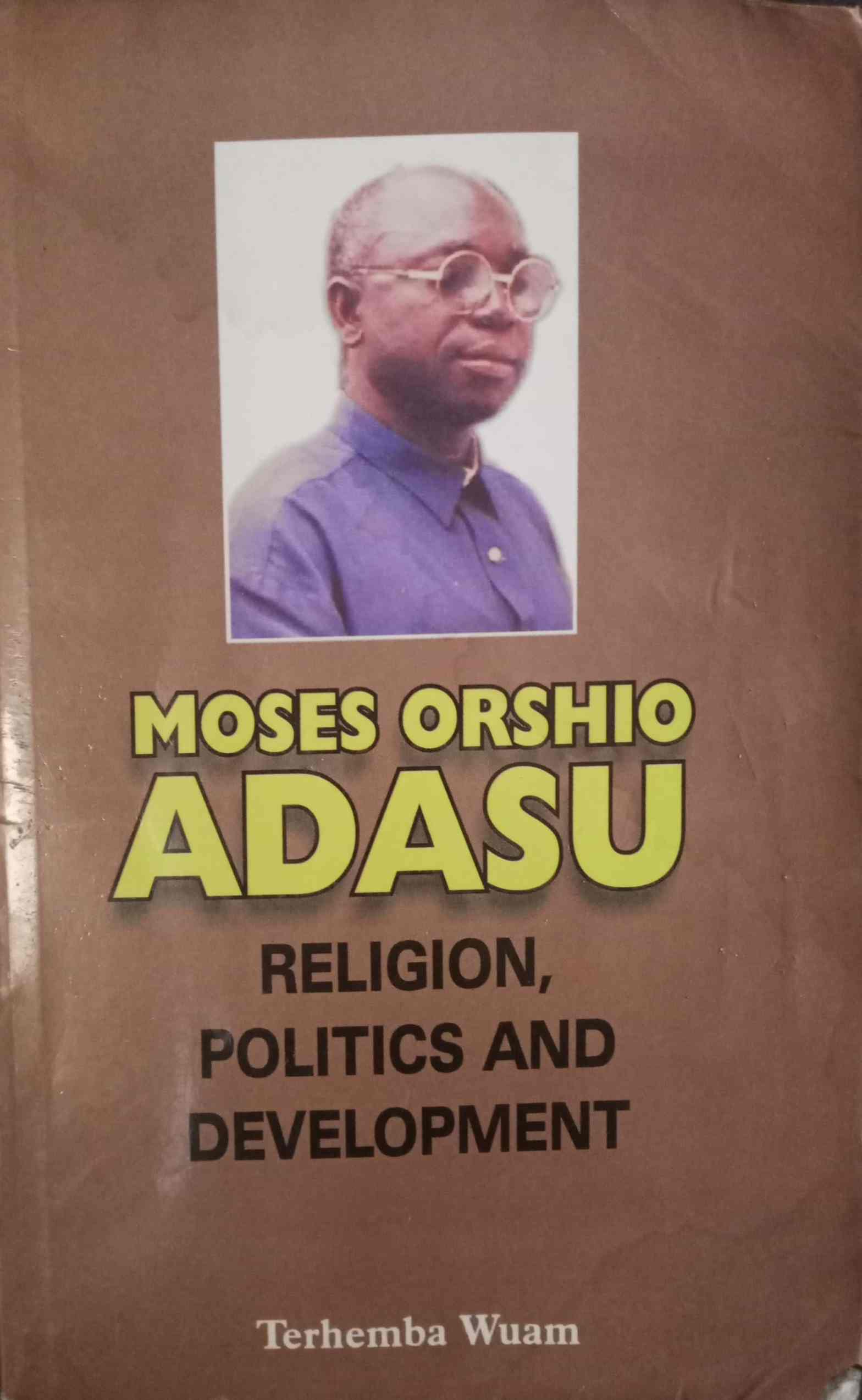
Book Title: Moses Orshio ADASU: Religion Politics and Development
Author: Terhemba Wuam
Publisher: Aboki Publishers Makurdi
Pages: 98
ISBN:978-8098-50-9

Vivian Inyang
Moses Orshio Adasu was a Catholic priest with no political antecedent before his assumption as the Governor of Benue state who was very conscious of the situation of Benue state. Adasu is remembered as a man of his words who offered a selfless service to the people of Benue state during his reign as the governor. His government was seen as making promises and striving hard to keep them. Above all his virtues of honesty, hard work, accountability and love for knowledge made him to be loved by all. His leadership drive can be used today to better develop our society.
Wuam has put together in his 98 paged book a man whom the people thought, as a cleric would not be corrupted by the dictates of his people or be a pawn of the political elite. He wanted to show that politics was not dirty per se but that individuals made it dirty. Amidst all these, his services to mankind and developmental drive were worthy of emulation. These form the very essence of this review.
Moses Orshio Adasu was born on 12 June 1945 to the family of Peter Tie Adasu and Monica Amar Adasu at Tse Adasu a rural community of the then Mbaamena clan of Shangar-Tiev district. It was shortly after his birth that the Tiv came in contact with politics of the western type in the 1950s. Prior to this period, the Tiv had forged political activities bases on their traditional dictates. In the 19th century their contacts with the Europeans had led to many changes such as introduction of administrative authority, forceful taxation and the introduction of chiefs and native authorities.
At the beginning of the 20th century the Tiv were introduced to Christianity and Western education by the Dutch Reform Christian Mission (DRCM) and the Roman Catholic Mission (RCM). Thus whichever be the case, converts were either Catholics or Protestants because of the establishment of a church or a school within your reach by either of the missions. As at this time, the RCM had reached Adasus’s part of Shangar–Tiev and had established a church.
Having started his primary education at age ten in 1955, at the St. Pius primary school Mbazerem he exhibited a high level of intelligence and was later transferred to Christ the King school and moved to the next class. Here he portrayed a greater potential both in academic and skills. He made the school’s football team as the captain and brought back several trophies in competitions organized for the whole of Jecira Federal constituency. His education continued to the catholic seminary, were the desire to serve mankind in the service of God was present in Adasu character.
At age Twenty-six, Adasu was among the seven candidates ordained as indigenous priest in 1969. The decision to become a celibate in Tiv land was a great deal as their father and father’s father were well known to take many women in as wives. To embrace celibacy and become a priest was then an act of strong will power.
Shortly after his ordination he took up a teaching appointment at Jos in 1972, in 1973 he moved to Otukpo to assume pastoral duties. Between 1975/76 he left for his postgraduate studies at St. John’s University, New York, USA. In 1978 he obtained a masters degree in religious education at the Catholic University of America, Washigton, DC. In 1978, he returned to Nigeria and taught at the Advanced Teachers college Akwanga in the department of social studies. In 1979 he was made a senior inspector of Religious and Moral Education, at the Benue State Ministry of Education, a position he held till 1980 when he was made the vicar general.
With the approval of the Catholic Church in 1988, he became a member of the Constituent Assembly, and played a key role in making the 1989 constitution. After the constitution Assembly, having developed much interest in partisan politics, he sought the approval of the Church to be involved in the process, this was frowned at by the church saying Catholic priest were not allowed to play active role in political parties by quoting the canon law 287 paragraph 2. Here was the beginning of his controversial relationship with the Catholic Church, however, Adasu was bent on going into politics whichever way.
He therefore joined the race to contest for the Benue governorship race. With a great campaign team, enormous energy, intellectual capability and hard work Adasu emerged as the Second Executive Governor of Benue state. And the first Catholic priest to be a governor in Nigeria. Under the Social Democratic Party (SDP) Platform, defeating Professor Ignatuis Ayua of National Republican Convention (NRC) in December 1991.
His tenure as the governor is worthy of emulation, he spear headed the takeoff of Benue State University in 1992, he initiated the J.S Tarka Foundation, he obtained approval for 330KV electricity project of Benue state, he initialed the meeting that gave birth to the hosting of the first Benue day in 1993, he reactivated and upgraded the College of Education Oju, he created new industries while revitalizing the existing ones at the same time, he was among the first governor to pay the 45% national salary increase in 1993, he resolved communal conflicts amicably and taxed those who damaged properties. He appointed those who knew the job and wear ready to work, he even went as far as giving appointments to members of the opposition party. He appointed party members who were experienced and not merely party sympathizers. Projects that he started included BENCO roof tiles, Kastina Ala Friut Juice Company and the Mbatiav Cement Factory.
Adasu, as civilian governor under the aborted Third Republic served the shortest tenure with much impact in the history of governance in Benue state. His tenure was shortlived by the General Sani Abacha Military coup of November 1993. His stay in office lasted from 2 January 1992 to 17 November 1993. If he had stayed longer maybe he would have achieved more. Insight from this short work is therefore that good governance can be transformed.
In order to be part of the world’s developed economies, Nigeria needs to adopt certain measures which include investment in human capital development, infrastructure, institutions, and structural transformation of the economy, which Adasu clearly portrayed during his tenure. Under him, the profile of Benue state was uplifted and made to have a friendly relationship with the Federal Government. His projects were commendable and appreciated as it increased the educational, agricultural, and economic situation of the state.
We must understand that, natural resources alone are no longer a guarantee of wealth. On the contrary, they can prove to be a curse. The combined lessons of economic science and of world development in the last two decades makes it abundantly clear that human capital is the driver of the wealth of nations. Human capital, technology, innovation and knowledge are central to growth and economic prosperity. Investing in people is ultimately about creating the right environment where talents can flourish. We must reframe the paradigm underpinning all our national development efforts to focus on people, skills, intellectual capital and the knowledge economy.
Vivian Inyang is with the department of History and International Relations, Veritas University Abuja.
 NIGERIA REVIEW OF BOOKS
The content herein this book is most quintessential
LikeLike