Sunday Moses Adebayo Aloko
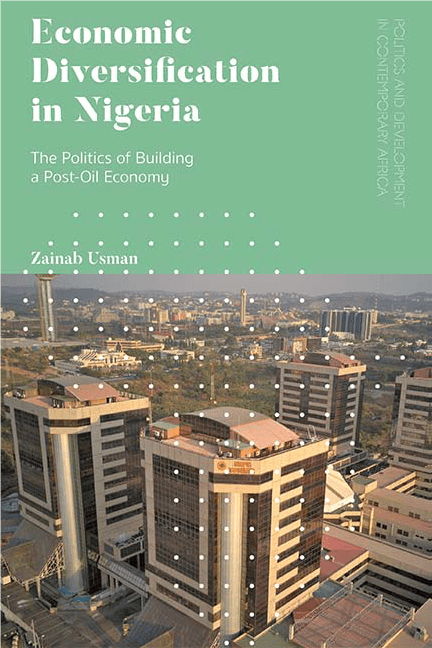
Book Title: Economic Diversification in Nigeria: The Politics of Building a Post-Oil Economy,
Author: Zainab Usman
Publisher: ZED Book, Bloomsbury Publishing Plc., London, 2022
Pages: xiii+292 pages
ISBN: 978-1-7869-9394-6
Zainab Usman’s book, Economic Diversification in Nigeria: The Politics of Building a Post-Oil Economy was published in 2022 by Zed Books Bloomsbury Publishing Plc. It is a path breaking study, which has been added to the Financial Times best books of 2022. The study was informed by the current international economic landscape, in which many countries depend almost entirely on oil revenues, while providing a thorough explanation of the challenges of development faced in low and middle income countries, despite their rich hydrocarbon resources. Given the current economic realities of the world, which has seen nations make drastic transition to alternative renewable energy sources in addition to daunting environmental concerns, the author argued that economic diversification inevitably becomes imperative if oil producing states want to achieve sustainable development.

Against this background, Zainab Usman argued that the major development challenge Nigeria is currently faced with is that of deliberately and consciously working towards economic diversification beyond its longstanding dependence on oil since the oil boom of the 1970s. The author identified the negative effects of Nigeria’s over-reliance on oil revenues, some of which include vulnerability to price fluctuations in the international market, which often affects government’s budgeting, leads to limited job creation, economic instability and the non-prospects of long-term economic growth. In her search for solution to the crisis, she provided a comprehensive analysis of the different successful strategies adopted by countries with similar economic challenges, in achieving meaningful development. Some of the examples include Norway’s sovereign wealth fund and the United Arab Emirate’s tourist and financial sectors. In addition, the challenges being faced by countries in the process of diversifying their economies were discussed and recommendations for improvement and implementation in Nigeria was provided.

Through the aid of economic data, interviews and policy documents, Usman analyzed and opined that Nigeria’s successive failed attempts at economic diversification is deeply rooted in its political structure, which has been characterized by an unstable distribution of power among groups, individuals, and actors at various institutional levels. She called for new approaches and frameworks of thinking through the challenges of development in oil-rich states such as Nigeria. According to her, some of the challenges are difficulties in sustaining growth over a given period, diversification, distribution of proceeds and realizing human development. She explains that the prevailing condition in the country has led many to attribute Nigeria’s development challenges in the midst of plenty to an “oil curse” and a neo-patrimonialism environment, limiting the prospects of economic growth and development. Her analysis of the problematic, has proposed what she considers a more encompassing alternative, capable of tackling the political landscape of Nigeria.

This is because Nigeria has undergone many reforms in the oil sector over the past fifty years. After a downward slide in the 1980s and 1990s, the country’s growth seemed to have rebound during the early 2000s due to the transition of power to the democratically elected President Olusegun Obasanjo. However, she observed that political decisions began to undermine economic growth, which became mainly driven by non-oil sectors such as the entertainment industry, Information and Communication Technology (ICT) and banking and finance. The country suffered two recessions between 2016 and 2022, however, the oil sector has continued to account for about 80 percent of the country’s export earnings and 50 percent of government revenues, which Usman argued is where the concerns of diversification lie.

According to Usman, regardless of the regime in power, the unstable political settlement and sharing of power has led to a perpetual state of crisis management by policymakers in Nigeria. Consequently, policy orientation has been largely geared towards macroeconomic stabilization, the revival of growth and easy quick fix reforms. This has resulted to a very little political opportunity for land reform policies, deregulation in the petroleum sector and reforms in the civil service, capable of increasing productivity in the Nigerian economy. Thus, although policy reforms are initiated, they most often than not focus on short term economic goals of stabilization instead of a long-term outlook that is able to bring about structural transformation and a solid base for economic diversification. The author equally explained that to tackle the development challenges facing Nigeria, an accurate diagnosis of the development challenges faced by other rich resource countries is imperative. Therefore, while the traditional frameworks of an oil curse and that of neo-patrimonialism as the root cause of the problem have helped in providing plausible insights to the discourse on Nigeria’s situation, their influence on policy thrusts have been disproportionate and largely unsuccessful in stimulating systemic transformation.

Furthermore, Usman warns that if policymakers in Nigeria are only concerned about managing revenues, it will be very difficult to realize structural transformation. In addition, she argued that if all the problems are narrowed down to the commodity itself, critical structural domestic and global economic features such such as history, population size, social composition, private sector development as well as the supply of labor would be left unattended to. Drawing from the lessons of Guyana, another oil-rich country in Africa, which has not faced the same development challenges, she demonstrated how limiting these challenges to the resource itself may not account for the variation seen among resource-rich countries of the world.

On the question of the climate crisis and decarbonization challenges, Usman brought to the fore how important they are in addressing Nigeria’s age-old challenges of economic diversification – especially as it concerns a post-oil future. In her thoughts, the Nigerian government has to address their implications for not just policymaking, but also revenue generation and management. She was however worried that the prevailing discourse on the need to diversify the Nigerian economy has been too focused on the risks involved, while daunting climate change has created new opportunities for structural changes and transformation. For instance, Usman is of the opinion that the role of the government in promoting economic development would include creating an enabling environment, through supportive policies such as investing in critical infrastructures such as transportation, electricity, education and fostering innovations that attract direct foreign investments into Nigeria. This will also go a long way in transforming ailing manufacturing industries in Nigeria into exporters of finished goods, away from oil.

She posits that scholars and policymakers should look into that even as the demand for oil in the international market is on the decline. This, by implication, means that the prevailing models of development are in dire need of new approaches. Although the hydrocarbon challenges facing Nigeria are substantial, Usman’s book provides an approach that is solution-oriented in order to better understand Nigeria’s unique challenges of development. In this sense, policymaking, which focuses on ways of achieving economic diversification while also tackling economic, political and social consequences can provide an opportunity for Nigeria to achieve the structural transformation that will be crucial in addressing its development challenges as the efforts at decarbonization continues.

The major strength of her work lies in the extensive use of case studies and empirical evidence. All arguments made were backed up with a compendium of data, which makes her analysis compelling and convincing. Most importantly, it provided practical recommendations that can turn around Nigeria’s challenges of economic development if policymakers and stakeholders put them into use. However, a more detailed analysis of the possible risks and challenges often associated with all the diversification strategies outlined in the book would have made the study more impactful and rewarding.
 NIGERIA REVIEW OF BOOKS