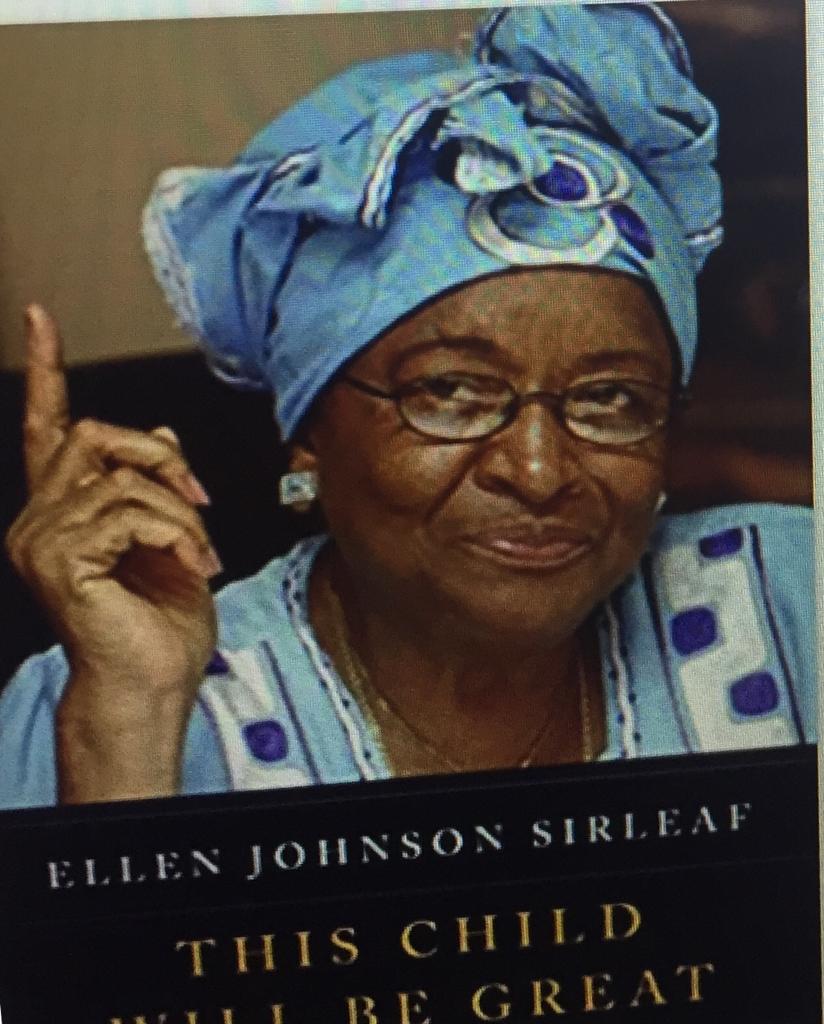
Author: Ellen Johnson Sirleaf
Publisher: Harper Collins E-Books, Australia, 2009
Pages: 353

Rotimi Olajide Opeyeoluwa
This book of 353 pages put in perspectives, the varied interesting story of a great personality, her accomplishments, travails and dazzling heights and an obvious intersection with her country of birth, Liberia, earning her the distinction of being the first female President and by extension Africa’s. An intriguing story filled with several twists and turns which could break a faint-hearted person. Ellen Johnson Sirleaf is indeed a great woman imbued with the heart of steel. Her determination and enormous self-confidence propelled her actions and ensured she pursed her choices regardless of what obstacles that stood before her.

Ellen Johnson Sirleaf is an epitome of industry, hard work and flaming determination. She was able to tear through the veil of societal complicity against her dreams and scored such a hisotirc feats which inspires successive generation of female politicians both in Liberia, Africa and even beyond. Because she fought back then the miraculous happened. At any rate, her rise to the pinnacle of power may as well be the high point of her trajectory in life, but reading her story reveals much more. Her story is deep, instructive and compelling. It is uplifting that even in the face of extreme hardship she didn’t flinch.

The book is organized into twenty chapters with a prologue and an appendix. It addresses the story of Ellen Johnson Sirleaf. The book is indeed robust and engaging from the first paragraph. In the prologue, she outlined how Liberia evolved into a nation. The history of Liberia is a history how a settler community tried to create a model community in Africa. It was not a stroll in the park. Even though Liberia can legitimately claim ancestry from the United States of America, it is quiet instructive to note that Britain was one of the first governments to recognize the new nation; the United States didn’t recognize Liberia until the American Civil War. The progenitors of Liberia had a motto, which is, “the love of liberty brought us here”.

Chapter 1, ‘The Beginning’ started with the story of her birth and evolution into a damsel that had the world to conquer. Upon her birth, a seer predicted to her mother “oh Martha,” he said. “this child shall be great. This child shall lead”. Indeed, it came to pass but not without passing firestorms of afflictions, tribulations, set-backs and anxieties. The author in the immediate passage of time was almost robbed off the chance of the prediction coming to pass because of the vicissitude of life. Her journey in life almost from birth was ridden with regression on all fronts but for providence, her life would have amounted to nothing.

When her mates were going to college abroad, she couldn’t because she was trapped in Liberia in a marriage with an abusive husband and four young sons with no bright future in sight. She was struggling to get educated, build a career, and get a divorce from a husband without losing everything she had. Due to the array of challenges stalled against her, her mother was wont to ask, “Where’s all this greatness that was predicted”. Her mother cried and sometimes laughed in doubt to the prediction but she never failed to pray. Left with no knowing what to do her mother resorted to praying ceaselessly.

Born native Liberian, her father was the son of a Gola Chief but her mother was of mixed parentage (from Liberia and Germany). This posed a challenge and a blessing. During the 2005 campaigns, rumour millers alleged that her ancestry was Americo-Liberian. This was an explosive charge given the long-standing settler-aborigine dichotomy in a fractious country plunged in part into a brutal (un)civil war because of such sentiments. She forcefully debunked the malicious rumour because as a child she spent considerable amount of time holidaying in her native land. She wore her ethnic identity as the daughter of a Gola Chief from Bomi County and her mother being from Sinoe. Her cosmopolitan background was further strengthened with the fact that in her family, they had both Christians and Muslims. There was no need for strife on account of religious adherence she admonished. By spending sufficient time in the village, she was able to pick some few native Gola words and converse and this served her well as she was spared from being executed in a military gulag during the Doe era. She remained connected to her native roots. She maintains that in the end she has remained so throughout her life, first and foremost, ahead of everything, a Liberian.

In chapter two which she titles, Childhood Ends. The chapter begins with a somewhat sudden twist in her life. Her father who was an active politician and a member of Parliament in his early forties suffered a massive stroke that left him paralyzed till the end. This sudden turn of event affected him and his dependents beyond measure. The economic toll and dramatic change impacted her life and those of her family in a most profound manner. It was under the cloud of her father’s illness and the uncertainty to push her education beyond her final year of high school that she met the man who was to be her husband. Named James Sirleaf, that encounter further alienated her from the threshold of her beautifully envisaged dreams in ways she did not know at the advent.

They met at the movies. James Sirleaf was older than her by seven years. Beyond that, he had been educated at the renowned Tuskegee Institute in Alabama in the United States of America. His charm she confessed was too hard to resist. They began to see in earnest and she was head over heels in love with him. He jealously wanted her all to himself and soon began to date her exclusively. When it became noticeable to her parents, they cautioned her but she was a woman already madly in love and wanted to be with him for life. She weighted her options. Her father’s stroke had shut the prospects of her travelling abroad for further studies, so she caved in to the tradition of early marriage.

This was barely after she left high school in 1956. In quick succession, she bore boys within a year. The first on January 11, 1957 and the second on December 31, 1957. The marriage was rocky almost from the get-go. This was not unconnected to James getting on well and fine with life as anticipated. Unable to get the kind of job he had anticipated, he continued to live with his mother and young family while hoping to get his professional feet steadied. Under such a circumstance, Ellen elected to get a job in support. She started as a secretary for the Stanley Engineering Company. Shortly after, she moved to Elias Brothers’ garage as an assistant head of finance. This seemingly attempt to help support her fledging family was to turn into a mighty stream that will lead her to her future professional developments. As for her husband, he too secured another job as a teacher at the Booker Washington Institute, a vocational high school, and later moved to his dream job at the Ministry of Agriculture. At that time, they had four children, all boys. Ellen, stated that in the marriage, her husband always “did enough to hurt but not enough to maim or kill, just enough to keep me in a state of fear”.

In chapter three entitled, America Again. The author storied about her divorce. She narrated the difficult aftermath. She wrestled with the fallout such as the uncertainty and emotional whirlwind. Nevertheless, because she felt it was necessary to move on, she forged ahead and sought to build a career in the absence of a husband but she was lucky with her choice because of the support of her family. Her mother took her in for a while and her siblings gave the required emotional support as necessary. With her gaze set on for career accomplishment she sought for greater opportunities. The opportunity came in 1969. She represented the Treasury Department at a conference organized by the Harvard Institute for International Development. She alluded that Liberia could not continue to “stand on the wrong foot and wobbling”. She averred that the “policies weren’t working. Someone needed to stand up and say something, and I saw no reason why that someone should not be me”.

That marked the beginning of attempts to destroy her for daring to speak up and factually. Sensing the possibility of punishment upon return from the conference, professor Papanek who was in attendance requested that she considers leaving Liberia for a moment. Once she agreed to the request for her to move to the United States, she through the help of professor Papanek secured a fellowship at the Harvard University. She gained admission into Edward S. Mason Fellows, Harvard’s oldest and largest international program but first, she would go onto Economic Institute at Colorado. It was after she was done with that that she proceeded to Harvard for a master degree in Public Administration.

Chapter four entitled, the Tolbert Years. This chapter chronicled her experience under a new President. The former President, Tubman, had died while she was returning from her studies from the United States. Tolbert, the former vice-president was sworn-in. She wrote about him as a man caught in the middle of wanting to initiate reforms but caught in the web of internal contradictions which made it practically impossible for him to move forward. It was under this climate of uncertainty that her secondary school alma mater, the college of West Africa, in November of 1972, invited her to deliver a speech to the graduating students. Fuelled by the perplexities of the moment, she delivered a speech which she titled, “Some Fundamental Constraints to a Liberian Society of Involved Individuals”. It was a scathing rebuke of the governing elites and the abnormalities which seemed normal. It sparked anger and calls for her to be dealt with within the governing elites. Her supervising minister in the Ministry of Finance wanted her to be “fired” but the President refused. She said to his credit, thought he refused such counsel but the misgiving about her was too deep. However, she was increasingly side-lined. As deputy finance minister, she leveraged on her international connections to opt out by seeking for a job abroad, which she took on secondment to the World Bank. For Ellen, it was a time of strategic withdrawal but certainly not surrender as time would prove.

At the World Bank, she acquired both connections and uncommon exposure at the global level. She moved to the United States and was subsequently posted to Latin America, Barbados, Brazil and Kenya. She started as a loan officer but within a short while was promoted to a senior loan officer and by April 1975, when Stephen Tolbert finance minister died along with five others, the newly appointed finance minister, James Phillips had requested her back to the country. Hence, after discussions with her, government of Liberia and the World Bank, it was agreed that she should be seconded back to her home country. By the time she returned home the country was in a flux. The years of economic turbulence and political uncertainty had grown and emboldened a sizeable crop of dissenters, insisting on both economic and political reforms. Many civil societies sprang up, and one of the most active was the Movement for Justice in Africa or MOJA in 1973. Calls for reforms became stringent and passion boiled over with security forces cracking down on the people. By April 14, 1979, riot broke out that shook the foundation of the country. The first but certainly not the last. After mass arrests, the government in responding to demands for reforms fired some ministers. One of the affected ministers was the finance minister and in his place was the emergence of Ellen Johnson Sirleaf, a position she occurred before “the car went off the cliff”.

Chapter five is titled, “the 1980 Coup”. The year 1980 was the beginning of the descend to the civil war that was to erupt a decade ahead. First in April, 1980, the military struck in a bloody coup that consumed the political leadership of the country. The president was killed in bed and several of his ministers were arrested and publicly executed. The people hailed the event as a revolutionary putsch; however, it did not take long before the party was over and the nightmare began. The leader of the coup was Samuel Doe, twenty-eight years old, master sergeant. His reign was brutal and nasty. Killings, erosion of civil liberties, corruption and ethnic rivalry and domination of his tribe over others became the norm, in a badly fractured country. Even though she had lost her job as finance minister, Ellen was appointed as president of the Liberian Bank for Development and Investment. Not long after, Ellen felt dissatisfied with the turn of things and leveraged on her secondment from the World Bank to pull out, she packed her bags and returned to the United States.

Chapter Six is titled Climbing the Corporate Ladder. She remained in the World Bank for just a year under the leadership of Robert McNamara, a man of profuse impact on the bank. She left the World Bank for Citi Bank becoming the first African woman to be appointed vice-president and was posted to the regional office in Kenya. She spent considerable amount of time travelling the length and breadth of East Africa. As she climbed the commanding heights of the corporate world, her mind was always at home in Liberia and she found ways around connecting with her native country.

Chapter seven entitled, “The 1985 elections”. By the summer of 1983, the military head of state, General Doe, announced a timetable for returning the country to the path of civilian rule, an act which became a defining moment in both the life of the administration and the country. Like most despot of his time, even though he acted as though he wanted democracy, he was in reverse undermining the very process leading the democratization process. By the stroke of the pen and without any shred of justification, he disqualified at will, manipulated and intimidated perceived opponents with pleasure. As the smokescreen would evaporate, Liberia was plunged into a crisis which snowballed into a civil war that consumed Doe, his government and thousands of lives that became intractable to resolve. However, within the intervening period, Ellen Johnson Sirleaf returned home to join the political process. She joined the Liberian Action Party, a political party determined to wrestle power from Doe, thinking that her strength of character, prestige and resolve will do the magic. She was dead wrong as Doe dogged in with all manner of subterfuge. The under the table antics of Doe to drive off the race, only strengthened her to pursue her dream. In the end, she was arrested and detained up trumped on charges by a special military tribunal. Her detention sparked protest which solidified a special bond she forged with the women of Liberia and eventually came in handy in the years ahead as she ran for the Presidency in the post Doe era. In the end, as she was released from prison, she declared her intention to run for a seat in the Senate, which she won but in protest at the brazenness of Doe, who rigged his path back to the presidency, she declined to take her seat. Doe was able to rig his way to power because he was in control of the electoral commission and security forces.

Chapter Eight; which she entitled, “The Attempted Coup”, saw a country tottering toward anarchy as Doe clamped down on opponents and grew more oppressive holding on to power at all cost. It was under this climate, that General Thomas Quiwonkpa, a former member of the Doe government who had some disagreement with the despot fled Liberia to the United States and from there returned to effect a military takeover on November 12, 1985. Though the coup was initially hailed by the people of Liberia, it soon failed. Doe launched a massive manhunt with security forces committing heinous crimes such as killings and arbitrary detention. Both real and perceived opponents of the Doe regime were either killed or dragged into detention, Ellen Johnson Sirleaf was picked up and clamped into detention. General Quiwonkpa was killed and his people of his ethnic group-the Gio and Mano of Nimba County, paid a heavy price. For Ellen, she spent nine months in detention.

Chapter Nine: Escape. By the time she came out of prison the political atmosphere in Liberia had changed with ominous implication. Her political party had since dropped opposing Doe’s fraudulent election and had chosen a path of least resistance but not Ellen, whose standing as a credible politician had become established. With rumours of an impending arrest, she fled but not without a renewed round of arrests of political opponents of Doe. The drag net was closing in on her and many others, when she took to her heels and landed in the United States to start another round of political asylum. As she left for safety in the United States, there was sadness in her heart but with a resolve in her heart to return to her land of birth.

Chapter Ten which she titled, “Equator Bank and the Charles Taylor War”. Back into asylum, she needed and got a job with Equator Bank which dovetailed perfectly into her skills and abilities. Not long after she settled in the United States, her mother came to live with her. It was there she died, an event which shook Ellen Johnson Sirleaf to her foundation. Though far from home in Liberia, she was both observing events and remained a key precipitant of event by joining a group of exiles named Association for Constitutional Democracy in Liberia. In July 1988, Doe survived another coup. The coup like previous ones only further undermined government legitimacy and in return the government became more repressive. As events were spiralling out of control back home, Ellen’s path would cross that of Charles Taylor, a man who was to play a pivotal role in both the removal of Doe and exacerbating the bloody civil war which decimated lives and properties with overlapping effort in neighbouring countries. When Charles Taylor and his band of Two Hundred exiled dissidents made incursion into Liberia on the eve of Christmas day 1989, the movement, National Patriotic Front of Liberia (NPLF), as the group became known was an instant hit with the people. Years of repression drove a lot of people into the movement. The Government reaction of indiscriminate killings and other human rights infractions only strengthened the resolve of especially young people to find sanctuary with the group.

Chapter Eleven titled, “ECOMOG”. This chapter is devoted to the activities leading to and the eventual deployment of the ECOMOG to keep the shattered peace in Liberia. The chapter detailed the abrupt but violent end of the Doe government. A government which ascended in a fit of violence ended in the same way. Yet the death of Doe didn’t bring the civil war to an end neither did the country get peace. Rather, the country continued on this downward spiral to the abyss of extinction with mounting deaths and wanton destruction on a frightening scale. The ECOMOG initiative hailed as the first of its type where a regional economic block will undertake a peacekeeping and later enforcement operation was itself caught in a series of web with setbacks and successes until Charles Taylor became President.

Chapter Twelve titled, UNDP and Rwanda. In-mid 1992, Ellen Johnson Sirleaf was recruited into the United Nations to become assistant administrator and director of the Regional Bureau for Africa of the United Nations Development Programme with the rank of assistant Secretary General of the United Nations, a job which made her the first woman to hold such a sensitive post. With this job, she had to tone down on her involvement in the domestic politics of Liberia but that was not for long. She was still at the UNDP when the Rwandan genocide broke out. Distressed like all with moral conscience, she was appointed by the UN with some others to undertake an assessment of the situation on ground in the immediate aftermath of the genocide.

Chapter Thirteen titled War Some More/1997 Elections. In October 1992 the ceasefire was undermined by Charles Taylor’s inordinate ambition to capture Monrovia, the capital he had long coveted. With the chaos came more deaths and destruction, yet Taylor did not care as long as anything or anyone stood in his way to the presidential mansion, he was determined to knock it off. The bloodbath provoked ECOMOG into a military offensive overdrive as well as another round of diplomatic negotiations. Even though Ellen was faraway in the United States, her shadow was not far off as she was asked by a group of concerned individuals as early as 1997 to return home and contest. When she heeded the call to run, it was obvious from the get-go that it was going to be a tough one. Charles Taylor had all the advantages and used it to maximum effect. The elections came and he won. Though Ellen Johnson Sirleaf was defeated but not silenced as the ensuing events proved.

Chapter Fourteen entitled, “Self-Imposed Exile, or Exile Again”. Once Taylor was inaugurated as president, Ellen returned back to her base in the United States but kept pace of development through periodical visits and maintenance of contacts with the home back. Though Taylor offered her head of the social security agency that would not stave off a confrontation between both parties as Taylor despised being criticized and Ellen was regarded as a thorn in the flesh of a government in which she served in. The government began to target some opponents such that when in December1997, Samuel Dokie, who had fallen out with Taylor was abducted and killed along with his wife and two other relatives, the uproar was deafening. The death of Dokie sparked a massive protest and tepid government response to find the killers. Emboldened by series of atrocities such as flagrant abuses of human rights, looting of the national resources, and decimation of the economy, Charles Taylor turned to undermining national security of Sierra Leone and others such as Guinea. With massive evidence of his complicity in the Sierra Leonean wars, the international community responded by imposing some sanctions. However, within the intervening period, Ellen Johnson Sirleaf had been appointed as Chairman of Open Society Initiative for West Africa, OSIWA, a powerful civil society organization. She used the office to raise funds to host a conference for a true reconciliation in Liberia by inviting all stakeholders in the country. The President, Charles Taylor declined participation and opening boasting that, “I have God and I have guns-I don’t need anybody else”. He was fatally wrong as time proved. The country was plunged into another round of bloodletting and Taylor having alienated critical stakeholders both at home and abroad, was only a matter of time before the house caved in on him.

Chapter Fifteen entitled, Accra and the Transition. With the ensuing round of war came another round of peace talks in Accra, the Ghanaian capital. All the groups and splinter rebel movements demanded that Charles Taylor must vacate power in the interest of peace and stability in the country. Hemmed in and baying for time, he agreed to come for the peace conference in the hope of buying time before launching a massive counter-attacks which never came. While in Accra for the peace talks, the Chief Prosecutor for the Special Court for Sierra Leone, American David Crane stated that, “bearing the greatest responsibility” for war crimes, crimes against humanity and serious violations of international humanitarian law in Sierra Leone since November 30, 1996. The statement further stated that, “My office was given an international mandate by the United Nations and Sierra Leone to follow the evidence impartially wherever it leads”. Crane reaffirmed that, “It has led us unequivocally to Taylor”. With the indictment over Charles Taylor, the dynamics changed dramatically as Taylor resigned and moved into exile in Nigeria. With the change of guard, Ellen Johnson Sirleaf emerged again. This time as head of Governance Reform Commission in the interim government.

Chapter Sixteen titled, Becoming President. Even though she had built a seemingly formidable reputation as a technocrat of international repute, Ellen’s chances to clinch the presidential seat hovered somewhere between slim and none. The media and intelligence community did not think much of her venture, yet she forged ahead with little money and a society that did not think much of giving a woman a chance and to cap it all, she was running against the legendary football star, Gorge Weah. She agreed that the odds were stalked against her but she is a person wired by varied experiences to run against the odds and she did. Once she convinced her relatives, she joined the presidential race. The field was crowded and it was not likely that anybody will emerge victorious at the first ballot based on analysis. The 2005 election was intense and after the first ballot, none of the contestants manage a clear victory. She came second to Gorge Weah which forced a run-off. After the run-off, Ellen was elected the first female president of Liberia and Africa in an election that was indeed historic.

Chapter Seventeen entitled Inauguration Day. It was euphoric and was regarded as a moment of hope and possibility for both Liberia, Africa and the rest of the world. She took the oath of office and stated her determination to rebuild a country shattered by years of wars and instability. On a personal level, Jennie her sister said, “well, our baby has finally accomplished this long last goal! The old man’s prediction has come to pass”, finally the predication that, “This child will be great” finally came to fruitful. The task before her was herculean and she made a pledge to do her best in the presence of many African and world leaders that found time to grace the occasion.

Chapter eighteen titled The First Hundred Days. Not long after, she took office, the honeymoon ended. Reality set in and the daunting task of governance demanded that she hit the ground running, which she did by ensuring the maintenance of peace and stability. Almost in concurrence with the task of running a country, the case of Charles Taylor became a recurring decimal requiring her attention even as she attempted to evade the issue. The more she demurred, the more the issue continued to haunt her and her country at every turn. The international community wanted Taylor tried for war crimes. It was a tricky situation which if not well-managed could undermine both Liberia and the West African sub-region. At any rate, Nigeria released Charles Taylor after a massive United States led pressure and the Liberian government quickly led him into the hands of the Special Court in Sierra Leone.

Chapter Nineteenth titled, Some Challenges Ahead. To say the task of re-building a war-ravaged country is no child’s play is stating the obvious. She plunged into the task with zest and much gusto, regardless of the fact that there were pockets of disaffection on the handling of the task of governance. She admitted her awe at the enormity of the task at hand but that it was a task she was elected to undertake on behalf of the people whose hope had been reposed in her and that there was no going back on her determination to rebuild her country.

Chapter Twenty titled the future. Ellen Johnson Sirleaf’s ride to the presidency was long and bumpy but in all, she developed enormous skills for the demands of the office. She readily alluded about her confusion as to whether a leader was born or made, she however, attested to the fact that regardless, a leader must have convictions and the courage to undertake the necessary cause of action and must be sacrificial. A leader must readily meet the expectations of the people at all times to continue to earn their trust and preserve legitimacy and see a brighter future ahead.
 NIGERIA REVIEW OF BOOKS