Okpeh O. Okpeh, Jr., FHSN
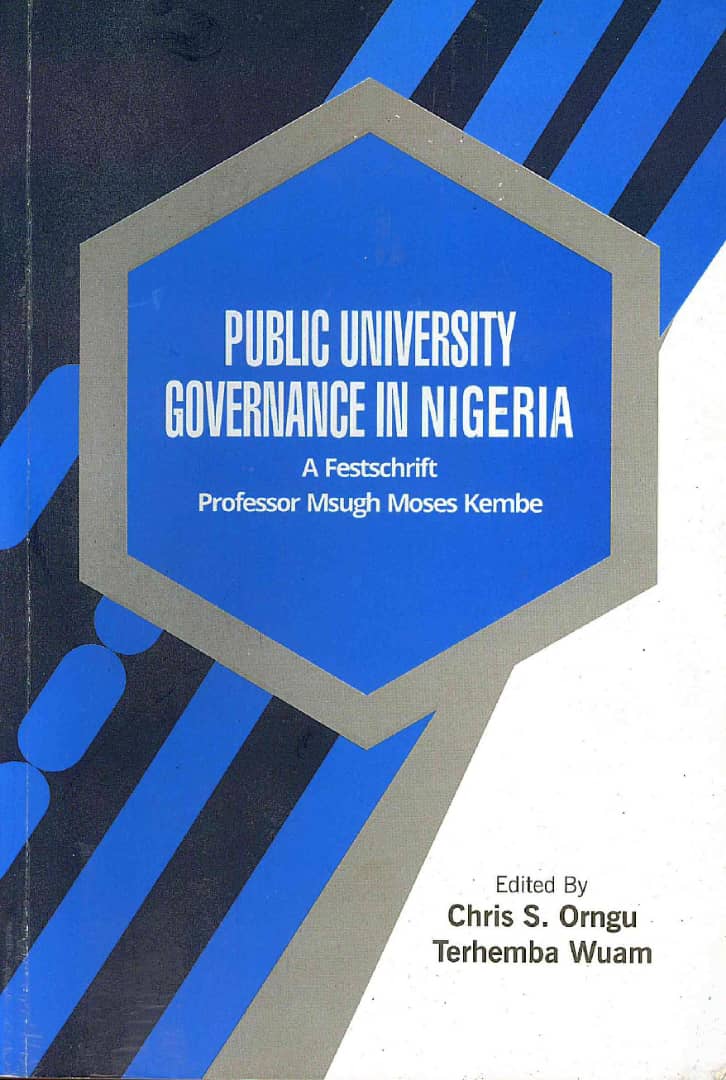
Book Title: Public University Governance in Nigeria:
A Festschrift Professor Msugh Moses Kember
Editors: Chris S. Orngu and Terhemba Wuam
Publishers: Cosmopolitan Book Series
Pages: 319
ISBN: 978-978-978-157-0
Universities are centers of research, teaching and learning established for the sole purpose of generating relevant knowledge required for the development of the societies where they exists. In this regard, universities exist as centers of excellence where knowledge is produced for the transformation of society. When the university first evolved in Europe, it was conceptualized as a universal concourse of profound knowledge, a place where different people meet and interact; a citadel where ideas interface, most times clash, are constructed and deconstructed; in essence, a liberal social space for the communication and circulation of refined thoughts. By virtue of the liberal values which underpin their existence therefore, universities are originally intended to be cosmopolitan in nature and outlook; attracting diverse people and ideas from different backgrounds and performing multiple, complex and very often intricately interlocked tasks. Arising from this, universities are globally distinguished by the quality of research output and relevant knowledge they disseminate and the purposefulness, dynamism and gravitas of the leadership they have and /or possess. A good mix of these variables would most definitely impact the type and quality of governance they operationalize as critical factors in their steady growth and development.
It is in the above context that the book – Public University Governance in Nigeria written in honor of Professor Msugh Moses Kembe, himself a seasoned scholar of repute and tested university administrator – comes into sharp focus and should be understood. A well packaged and edited tome by Drs. Chris Stanley Orngu and Terhemba Wuam, the volume is made up of fourteen well-researched chapters authored by a coterie of the very active and arguably, some of the most productive scholars in Benue State. The book navigates the very complex intersections between leadership, public university governance, the production of knowledge and national development, anchored on carefully and rigorously selected nuanced themes. It also interrogates some of the critical issues that militate against positive public universities governance, by scoping and dimensioning their various ramifications and implications on the functioning of the university system. Undoubtedly, the book is a useful contribution to the rapidly increasing literature on university education in Nigeria.
To fully comprehend the relevance of this volume, it is imperative we have an idea about each chapter, even if briefly. The book begins with an introduction in which Chris S. Orngu and Terhemba Wuam periscope what they adjudged as the giant strides of Professor Msugh Kembe, the Vice Chancellor of Benue State University (hereafter BSU), in whose honour the entire book is committed. The authors take the reader through the achievements of the Vice Chancellor in the period under review, particularly in the areas of internal revenue generation and the efficient mobilization and application of scarce resources; predicating university governance on the committee system in accordance with global best practices; staff training and capacity building; infrastructure development and expansion; ensuring the accreditation of an impressive number of postgraduate programmes across faculties and introducing new ones; digitization of the university; and the promotion of staff and students welfare, among many others. In chapter one, Chris S. Orngu deploying the critical lenses of the historian’s craft; explores the conceptual and theoretical issues public university system and governance have thrown up from the past to the present. He establishes a useful nexus between the emergence of public universities in Nigerian and the evolution of the University Idea. His conclusion that throughout their history, universities have never operated in a vacuum and that the knowledge they produce have mitigated societal challenges; is incontrovertible.
Global knowledge production and consumption are inseparably linked to the ways nations connect with each other and tap into the externalities of such globally acknowledged interactions. In this connection, an objective assessment of the performance of Nigerian public universities would be incomplete outside such matrix as global best practices. Chapters two to five are devoted to the various ramifications of this problematic. While Emmanuel S. Okla in chapter two discusses the global ranking of Nigerian Universities, Elijah Terdoo Ikpanor in chapter three examines the trials, travails and triumphs of state universities with the BSU example. From the analyses in these two chapters, it is evidently clear why Nigerian public universities are lagging behind in global ranking and how this situation can be ameliorated in the short and long terms. On his part, Terhemba Wuam focuses on the place of ethics and morality in the training of university students and the implications of these on the character and image of such institutions in chapter four. Citing examples from Europe and the USA, Wuam juxtaposed the practice of university ethics and morality in these places and Nigeria using Ibrahim Badamosi Babangida University (IBBU), Lapai, Niger State, as an example. His flexibility and all-inclusive notion of ethics and morality in public universities would certainly generate nuanced conversation on the subject. Gideon Ianna Jato and Vincent Tavershima Terna in chapter five examined the relationship between research, public policy and development. Their contention that the crisis of relevance public universities in Nigeria appear to be hemmed in is a function of the poor quality of research and the protracted gaps between our knowledge banks and industries; is instructive. They advanced far-reaching recommendations on how to improve this situation moving forward, which should interest education policy makers and university administrators.
Public universities function optimally on the basis of statutory and ad-hoc organs of administration. How efficiently these organs are deployed and managed by the university leadership determines the degree and extent to which policies are implemented and duties effectively discharged by stakeholders in the system. These themes captured the imagination of the authors of chapters six to nine in their various interventions. Martin Terngu Kpoghul tackles the role of statutory bodies in the functionality of public universities with the BSU example in chapter six. He discusses how statutory bodies have performed in the historical development of BSU since its inception in 1992. He concludes that the university would not have gone far, but for the due diligence and quality contributions of the operators of the organs of the university administration during the period in focus. In chapter seven, Chris S. Orngu isolates and analyzes university alumni associations as critical stakeholders in public universities. Drawing on a comparative analysis of the role of alumni associations in the USA and Europe, he beams his searchlight on the performance of the BSU alumni since its establishment over two decades ago. Orngu associates the sloppy performance of the BSU alumni to lack of focus and direction, intra-alumnus squabbles, leadership tussles and self-defacing politics of some of its members. Peter Ogbu Agogo interrogates the place of critical infrastructure in the science education needs of public universities in Nigeria in chapter eight. Drawing on the negative impact of the poor funding of public universities by their proprietors (Federal and State governments) and the consequences of this on infrastructure provisioning, Agogo acknowledges the attempts by the Tertiary Education Trust Fund (TETFund), a brain-child of the struggles of the Academic Staff Union of Universities (ASUU), in mitigating these challenges. John Ebute Agaba conducts a bird’s eye view survey of the educational sector and the challenge of quality education in Nigeria in chapter nine. Focusing on developments since the return of democracy in 1999, Agaba identifies some of the problems that have collectively diminished the quality of education in Nigeria to include but not limited to; poor funding and condition of service, infrastructure deficit and poor learning environment, policy inconsistency on the part of government at all levels, undue interferences in the functioning of the sector and lack of autonomy, etc, etc.
There is an intrinsic relationship between the health of the nation’s economy, the scope of government funding of public universities and the brain drain phenomenon. This is the preoccupation of thematic concerns of chapter ten, eleven twelve, thirteen and fourteen, authored by Frank Ter Abagen, Gideon Ianna Jato, Maria Ajima, Msugh Moses Kembe and Naomi Onyeje Doki, respectively. In his intervention in chapter ten, Abagen looks at the challenges associated with financing public universities in Nigeria and recommends new ways of tackling them through the deployment of practical and more efficient approaches that are cost effective. His admonition that overdependence on government for funding has eroded the autonomy of public universities in Nigeria, is therefore timely and should be taken seriously. While Jato establishes and explains the link between economic recession and the performance of public universities in chapter eleven, Ajima presents an entertaining and a critical literary representation of the plight of Nigerian graduates arising from a contradictions-ridden Nigerian economy in chapter twelve. She underscores the ordeal of Nigerian youths after toiling through university education and makes a strong case for skills acquisition. Kembe examines the phenomenon of labour migration and its implications on public universities in Africa in chapter thirteen. Associating this with a plethora of complex variables, Kembe situates his analysis within the context of the brain-drain syndrome and enumerated its implications on Nigerian public universities. He concludes with strategies on how best Africa (and indeed, Nigeria) can benefit from the international migration of intellectual capital while at the same time stemming the tide of brain drain from the continent. In chapter fourteen, Doki discusses the activities of middlemen and the implications of these on agricultural development in Benue State. Using the quantitative random sampling method matched with descriptive statistical tools, she was able to glaringly show how middlemen exploit farmers in Benue and what can be done at the level of government policies to checkmate this.
Generally, a circumspective appraisal of all the chapters as has been rigorously done in the preceding paragraphs would lead to the conclusion that the volume is arguably a massive intervention in the sphere of public university governance studies in Nigeria. Undoubtedly, it would attract readership from university administrators, education policy makers, members of the academia and the general public. The contributors and editors to the volume have offered us a rich menu of knowledge that would stand the test of time. However, the volume has some gaps, limitations and weaknesses which the editors should consider in subsequent editions of the book. First, there is no chapter on university unions, particularly ASUU. No detailed story of public university governance can be written without the contributions of the unions to the process. We must recall that ASUU as a critical stakeholder, fought for and ensured the institutionalization of democratic norms in the operation of public universities in Nigeria. The union was also instrumental to the establishment of TETFund which is today the major agency funding capital projects in all public institutions of higher learning in Nigeria. The omission of ASUU and other unions in a very important volume such this one limits the value of the book and the relevant message it is loaded with.
Secondly, I find it particularly odd that a chapter authored by a personality in whose honour the festschrift is published is included in the volume. In my almost three decades in the writing and publishing industry, I have never seen such. I can confidently tell the Editors, that this does not happen. The inclusion of that chapter which although very informative, has undermined the work as a festschrift. Thirdly, I feel the inclusion of a chapter on the impact of the COVID 19 pandemic won’t be a bad idea. Judging from the impact of this virus on university education in particular and education generally, future editions of this volume should consider how it impacted university governance. Fourthly, the volume is replete with needless textual, lexical and morphological infelicities. Personally, I counted over forty of such errors. There are also factual errors that should be corrected in subsequent editions of the book. Fifthly, the subject matter of one or two chapters are not in sync with the central idea and theme of the book. Festschrifts are usually organized around particular subject matters from which the theme of works are derived. There is no point including essays whose subject matters are at variance with those of the festschrift. However, notwithstanding all these gaps and limitations, the book is informative and educative on its subject matter and main theme of public university governance in Nigeria.
Professor Okpeh O. Okpeh, Jr, FHSN, is the president of the Historical Society of Nigeria and is with the Department of History and International Studies, Federal University Lafia, Nigeria.
 NIGERIA REVIEW OF BOOKS