Terhemba Wuam
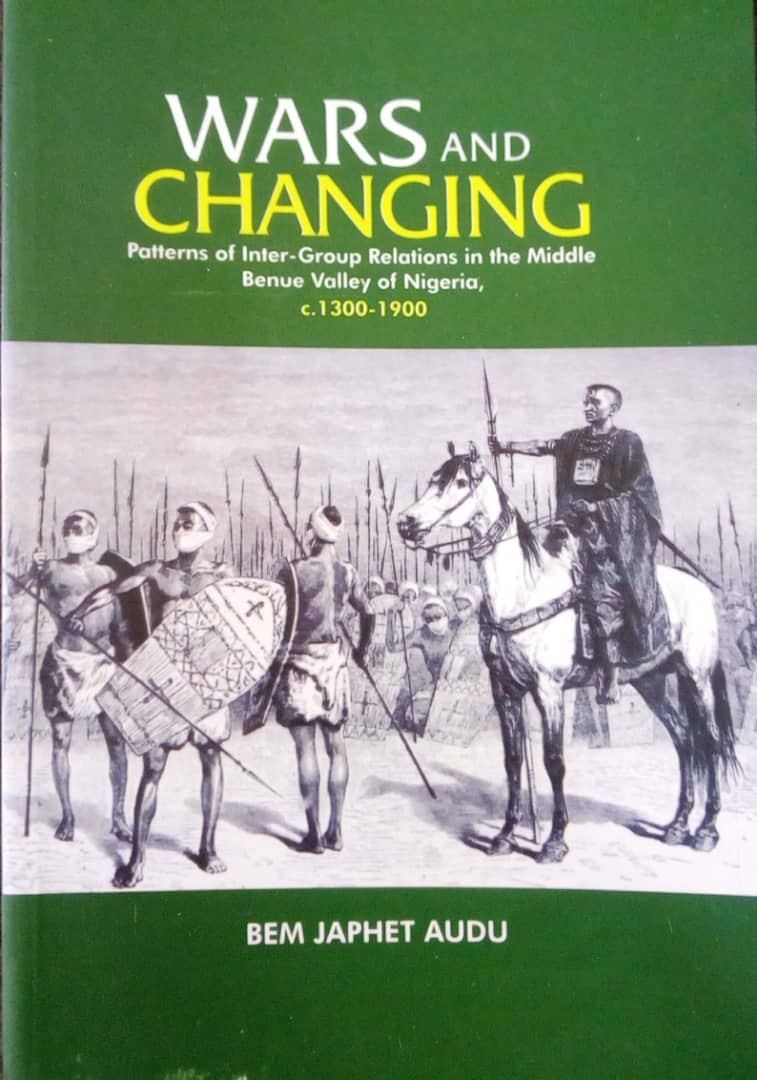
Book Title: Wars and Changing Patterns of Inter-Group Relations in the Middle Benue Valley of Nigeria c.1300-1900
Author: Bem Japhet Audu
Publishers: NDA Publishers, Nigerian Defence Academy, Kaduna
Pages: 170
War is given a bad rap. Often justifiably so because of the human suffering that comes with it. Yet the three things – money, religion and empire – said to have unified and integrated the world, since the dawn of human civilization are all depended on wars. Empires are built on success in war. Religious conversions are partly depended on wars and their outcomes; as is the adoption of currencies. War was behind the Roman Empire when the Israelites had to use Roman coins with Caesar’s head to when the British because of their imperial might made the pound sterling the global currency, and the present age when America as the leading victors of the Second World War had the dollar adopted as a global currency, and hence an even more globally integrated world.
On current trends, however, it is possible to hazard that this trajectory of wars determining which currencies become dominant may be aborted with a Chinese ascendancy that may not be from the result of war, but may be based purely on global economic dominance; and also of course on a huge military arsenal as the Chinese are currently acquiring. However, even at that the original Chinese foundation for their current growth derives from the Communist victory in the Chinese Civil War that ended in 1949.
Other benefits of war are drawn from the scientific and technological advances depended on military oriented research. War research, specifically military oriented research and technologies have also given birth to many advances that humans use on a daily basis in transportation, communication, food preservation and assembly line production – which was pioneered during the American Civil War of the nineteenth century that saw the need for mass production on the new discoveries of the Industrial Revolution.
Wars have also been significant in political organization and nation-building. The local example of the nineteenth century jihad in Nigeria is a vital case in point. The jihad created a supra-national state or more or less an empire that embraced hundreds of ethnic nationalities and states. The jihad enabled political authority over a territory bigger than the present northern Nigeria in which safety was guaranteed, trade could flow freely and political administration was uniform along a recognizable template.
Thus, although war is to be avoided as best as humanity can afford to side-step it, the historical reality has shown that it is war and its very conclusiveness that lays the foundation for a lasting peace that can be inter-generational.
Dr. Bem Japhet Audu’s Wars and Changing Patterns of Inter-Group Relations in the Middle Benue Valley of Nigeria published by the NDA Publishers is therefore a worthy contribution to the corpus of materials on the subject of war in Nigeria and on the continent, and with special and specific reference to the period before European conquest and colonization.
Like most war accounts written long after the event, the focus is on the political, economic and strategic ramifications and not on the humanitarian impact of the wars. To quote Professor Ojong Echum Tangban’s blurb of the book is to illustrate its broader strategic focus:
“This book is an insightful account of inter-group relations among the ethnic nationalities in the Middle Benue Valley in the pre-colonial period. It brings out in bold relief the roles of war and other dimensions of inter-group relations – economic, social, political and cultural in the shaping of the Tiv society during the period under review.”
Two other authorities, first, Professor CBN Ogbogbo notes too that:
“B.J. Audu offers a unique examination of how wars have shaped the relationship between the Tiv and their neighbours in the Middle Benue Valley. The book provides an interesting historicity on the complex patterns of inter-group relations in pre-colonial Nigeria.”
Second, Professor O.O. Okpeh, Jnr, avers that the author:
“…interrogates pre-colonial Tiv wars and the dynamics of inter-group relations in the Middle Benue Valley. A very detailed analysis of changes and continuities framed in the context of a group contacts, conflicts and transformations…”
These testaments acknowledges that Dr. Audu’s book follows the common narrative of songs, stories and legends of war in the peoples imagination as many societies and nations celebrate the exploits of war in their narratives. Indeed, very few have narratives that highlight or lament the suffering of people in wars in sufficient detail as groups that are victorious tends to emphasise the heroic and the defeated focus on their resistance and martyrdom.
A critical appraisal of Dr. Audu’s Wars and Changing Patterns of Intergroup Relations shows that his is an ambitious attempt. A condensation of 600 years of the history of wars and its implication on intergroup relations between the Tiv and their neighbours in the Middle Benue Valley from C.1300-1900. The question to ask therefore is to what extent is this ambition realized. It is what this review will seek to appraise.
Many scholars have alluded to the Tiv as been the last Nigerians, probably moving into the Nigerian territory from the 14th-16th century, a timeline that Audu also agrees with, which meant that their putative partners, the Fulani coming from the west and they from the east, predated them by probably a few decades by the time of their eventual meeting in the farthermost context eastern reaches of present-day Nigeria.
The pre-colonial history of most communities, bar, the Islamic north, that is of most preliterate societies is often unable to stretch back to the timescale proposed, as records are usually difficult to access – thus, the book’s most revelatory aspects actually kick in from the eighteenth century when two to three centuries of existing in the Middle Benue Valley expanded the Tiv population. The Tiv population grew naturally through increased birth and also through the incorporation of non-Tiv groups, into their fold. With population expansion and the rise of states, the stage was set for greater interaction among the groups in the Middle Benue Valley identified by Dr. Audu as the Abakwa, Akwana, Akwaya, Alago, Bete, Chamba, Etulo, Fulani, Hausa, Idoma, Jukun, Kamberi and the Tiv among others.
According to Audu, wars were prominent in “The stage of competition in inter-group relations in the area” (4) and that “conflict relations occupied a strategic place in the interaction of social groups in the Middle Benue Valley” (5). Audu’s Wars identified both intra-Tiv conflict and wars of an international or inter-group dimension involving Tiv clans and other ethnic nationalities. With regard to the latter, because the Tiv were not unified under one political authority, Tiv wars against other nationalities usually involved the bordering community against other groups i.e. the Tiv-Chamba wars, the Kunav-Udam wars, and Tiv-Idoma skirmishes.
These wars were as identified by the book, wars of Tiv conquest, expansion and consolidation in the central Nigeria area. Other wars were ones of Tiv resistance against conquest and extension of the jihad into Tivland. In some, the Tiv fought in alliance with other groups to further Tiv as well as the interest of their partners i.e. the Tiv and Alago war against Lafia. The Tiv also acted as mercenaries in some of the wars, especially those within the Nasarawa area, an example being mercenaries in the service of Keana.
Notable is the fact that the Tiv expansion into the Middle Benue Basin came at a time of the Kwararafa Confederacy decline. Audu notes that its decline created a political and geo-strategic power vacuum in the area because Kwararafa:
“…before the era was a predominant force with a superior military organization with dominant influence in the middle Benue Valley. Its decline in the early 17th century paved the way for the cultural exchanges and migrations in and out of the middle Benue Valley” (6).
The Tiv on their part, flowing out from Swem, their putative Eden, out of present-day Cameroon from c.1500s clearly positioned themselves as potentially the last major ethnic group to transit into the pre-colonial Nigerian area. At first, they occupied defensive positions on hills in the present central eastern borders of present-day Nigeria around the Benue-Cameroon axis, before their expansion into the greater reaches of the Middle Benue Valley as a result of a growing population that occasioned land hunger. Their descent from the hills opened them to their first conflict with other groups in the area when they began to come into conflict with the Chamba. And in Audu’s words, “The invasion of the Chamba caused great devastation on Tiv settlements on Ibinda hills.” (18).
Through the succeeding centuries, similar clashes became more common. The outcome of such clashes was for the Tiv to migrate further and deeper into the Benue trough, pushing other dislodged Tiv clans to move even further with the consequences being that in the nineteenth century there were “frequent inter-lineage wars and extensive displacement of kindred groups and lineages” (18).
While, the book is about Tiv warfare, the author in the second chapter equally provided an in-depth narrative of Tiv history, and Tiv socio-political organization with a detailed account of Tiv economy and trade relations within and outside the Benue valley, especially in the eighteenth and nineteenth centuries. However, the book’s focus is maintained on its central theme of wars and how they affected inter-group relations in the Benue valley. As such, the impact of external factors as the Sokoto jihad which began in 1804 and within the next decades traversed from Sokoto into the central Nigeria area and the European incursion from the mid-nineteenth century are clearly explicated.
The jihad’s military conquest established emirates within the Middle Benue Valley and pushed populations southwards towards the Middle Benue Basin. The relation between the emirates and non-emirates became characterize by wars and hence the desire of the Tiv to defend themselves and resist. Audu cites Ikimi to buttress the level of Tiv resistance thus:
“What gave the Tiv a reputation as fighters was the fact that they had to organize themselves for survival in the face of the determined efforts of militant Islam in the Sokoto Caliphate. The failure of the Caliphate to convert the Tiv to Islam must be partly explained by the toughness of the Tiv as fighters. Success in this regards, however, meant that the Tiv, like other non-Muslim groups near the Sokoto Caliphate, became liable to slave raids organized by the Emirates of the Caliphate. The Tiv, therefore, also had to organize resistance to such raids” (40).
Just as the Tiv resisted the Sokoto Caliphate, Audu dedicates a chapter to show how they also resisted the British attempt to penetrate the area, this time with varying degrees of success from the initial contacts of the mid-nineteenth century to the first decade of the twentieth century when their organization and weapons proved inadequate for the technologically enhanced firepower of British artillery.
In the third chapter “Pre-Colonial War Strategies, Tactics and Diplomacy”, Dr. Audu is able to show how a non-centralised polity like the Tiv were able to organize their military and the tactics they adopted in engaging other groups in warfare and diplomacy. In organizing their defenses for instance, the Tiv dug trenches, carried weapons on the farm, sounded their war drums and gongs, took to high grounds and shot arrows down on their enemies and those attacking them. The author reveals that some of the nineteenth century trenches can still be seen in Tivland, and one “At a village called Azaibo […] is about 5 km […and] this ditch was dug as a way of effectively tackling the Ugenyi warriors who came or launched their attacks on horsebacks and with spears” (70).
Broadly, Audu surmises that the Tiv were without a;
“…standing army nor possess cavalry but mobilized all able-bodied men to carry arms whenever there was need to defend their land against external aggression or to conquer more land. It is within the context of a non-standing army that they developed their war strategies and tactics of warfare. These strategies and tactics were dictated, partly, by the environment and geography of the area” (94).
Aside wars, the Tiv also engaged in diplomatic and inter-group relations with other groups. The earliest example was with the Fulani, whom the Tiv first met in the mid-sixteenth century and exchanged gifts with. The Fulani also are said to have left cattle with the Tiv for herding. The Tiv in the early days also made treaties with groups they territorially encircled, such as the Utange, who today have been assimilated into Tiv society.
A lot has changed since the end of the nineteenth century but it appears a little detail contained in Dr. Audu’s book still has resonance – expansion. To him,
“A very fundamental cause of most wars in the Benue valley in the period from the 1300s up to the 1700s and beyond were of Tiv expansion as seen in the Tiv migrations from Swem and dispersal into the Benue valley; and Chamba migration from the Camerouns up to Adamawa and then to Donga, Takum in present day Taraba State. Expansion was also visible in the wars in the Keana, Awe, Lafia and Doma areas of present day Nasarawa State. The factor of migration and population was closely related to the desire for territorial expansion and the temptation to exercise a reasonable measure of physical control of neighbours” (103).
The above quote though reflective of the pre-twentieth century situation, a review of recent happenings in the Benue Valley might point to a reenactment of a scenario of past wars among groups in the area. However, while such may look similar, the power dynamics and state/federal structure of modern Nigeria are designed to prevent group on group wars of annihilation and total control in a context of the clearly defined and fixed boundaries of groups and ethnic nationalities within state boundaries. Vital to prevent a backward movement to the past is a national security apparatus that was non-existent in the nineteenth century, and which now exist for the benefit of all Nigerians, irrespective of ethnic or religious affiliation.
Going back to the past, Audu is able to show that it was not all about warfare between groups in the pre-colonial Middle Benue Valley. That although the Tiv fought with the Chamba, prolonged period of peace would well have been the norm. That in times of peace, the groups interacted on several fronts: “… they fished together and learned fishing and farming from each other. This social and economic intercourse was so cordial that the Chamba claimed to have taught the Tiv the art of circumcision, fishing, spinning, weaving of cloth… The Chamba also supplied salt to the Tiv…” (105). This illustrates that the Tiv fought with their neighbours, but that they also had strong relations with them, with the upper Cross River groups of Bete, Yakoro, Yache and Egedde – whom the Tiv collectively refer to as Udam, for instance, they related and borrowed customs and had intermarriages.
A main theatre of pre-colonial warfare in which the records are more suffused relates to Tiv northward movements into the area of present-day Nasarawa in the nineteenth century, which opened them to a whole vista of relations that included warfare, trade, diplomacy, politics and social relations. The mixture of groups they related with, were also as diverse – the Awe, Doma, Lafia, Keana and the southernmost emirates of the Sokoto Caliphate. On the Tiv northern front, due to the large number of actors, they, out of necessity needed to form alliances i.e. the Tiv-Alago military alliance against the Katsinawa (119). Such an alliance was “mutually beneficial. Keana was assuring its political autonomy and survival when many non-Muslim monarchs were being displaced… In a sense Tiv power took the form of controlling the means of agricultural production, the land…” (123).
In essence, the wars the Tiv fought within the period under review brought them into contact with many groups, who because the new entrants were ready to fight for their right to exist in the area were accepted on equal terms as belonging and as major actors in the realpolitik of the period before 1900. A general current that permeates this well written and highly intriguing book of the pre-colonial period is that wars brought the Tiv and other nationalities together. By warring, the communities integrated. Post-war diplomacy, truces, and eventual peace pacts cemented long periods of peace that enabled intermarriages, cultural exchanges and economies to be integrated through trade and technological diffusion within the area.
When the British arrived, they met entities that though different, shared histories that commonly perceived the Middle Benue Valley as an area in which they could all call home. It was on this basis that the Tiv differed from the British, whose colonial enterprise being not of the settler variety, their conquest saw them imposing their authority despite fierce resistance; and for which six decades later they would depart, unlike the Tiv and others who saw the area as a homeland in which to invest and prosper in. Consequently, in spite of certain editorial issues noticed, it is credible to conclude that Audu’s thesis of wars leading to integration is well-argued.
The research behind the book is sufficient and the presentation is a worthy interpretation of a far-flung past that few dare to venture into tackling. Though the groups in the Benue Valley are unique and varied, their interactions and integrative processes do indeed go back for centuries, and should continue into the future. In summing up, it is worthwhile to conclude with my words in the blurb of Wars that: “The central thesis of this work identifies warfare in precolonial Africa as being integral to inter-group relations and nation-building. Highly recommended!”
 NIGERIA REVIEW OF BOOKS