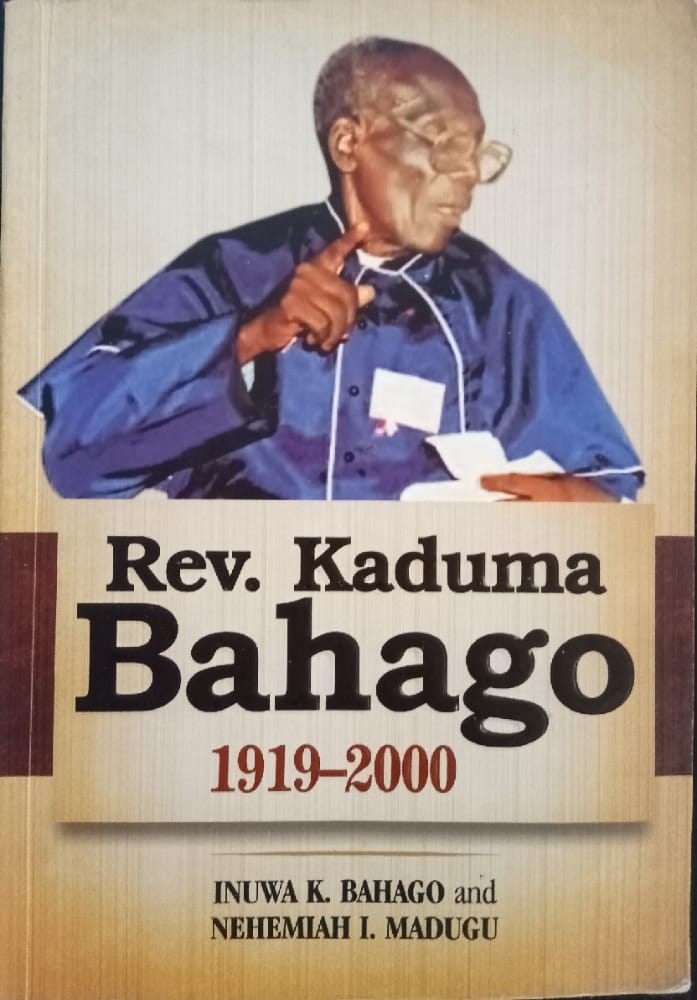
Book Title: Rev. Kaduma Bahago 1919-2000
Authors: Inuwa K. Bahago and Nehemiah I. Madugu
Publishers: Kaduma Bahago Evangelistic Foundation, Kaduna
Year: 2020
Pages: xiv+ 142
ISBN: 978-978-986-529-1
Terhemba Wuam
The art of biography as the study of man and his times gains credence in this volume on Rev. Kaduma Bahago. In Rev. Kaduma Bahago 1919-2000, the authors Inuwa K. Bahago and Nehemiah I. Madugu presents a biographical study which dissect the transformation of the life and times of the Rev. Kaduma Bahago, whose lifetime epitomizes the tremendous changes that his society underwent in the twentieth century. While primarily a study of the life of this inspiring pioneer Christian and ordained minister of God, it is also by extension an evaluation of the times in which he lived.
The Nigerian nation had just being amalgamated in 1914, five years prior to the birth of Rev. Bahago; and Northern Nigeria, the region into which he was born had been incorporated into the British colonial empire nineteen years earlier in 1900 as a British protectorate. The southern part of the country which had been opened to European and western intrusion earlier in the nineteenth century with missionary activities had been pulled into the orbit of modernization several decades earlier and for the northern part of the country, it was only the opening up of the twentieth century that would see colonial presence and missionary activities taking tentative roots in the upper reaches of Nigeria.
Rev. Kaduma’s life story would therefore begin in a changing world that would subsequently evolve differently from that of his parents and ancestors. The trajectory of his life would not harken to the tradition that his people had always known but would assume much that was different and based on the tenets of a religion and system that went back to ancient Judea, the Middle East and would be based on the society of Classical Greece and Roman civilisations that birthed the modern era of Western civilization that would become globally dominant as a result of the activities of European colonizing powers in Africa and elsewhere in the second half of the second millennium AD.
The coming of Christianity, western education and the colonial system with its political and economic systems would bring disruption to the traditional makeup of African societies. New ideas, a new religion, a new economic and political system would encounter and modify African societies to varying degrees. Politically and economically all Nigerian societies, felt the changes, as these were imposed by colonial authorities following the British by virtue of their successful conquest of Nigeria. In the sphere of religion, the impact, however, did not witness wholesale absorption into the diverse multiplicity of Nigerian communities.
The distinction was that many of the Nigerian groups that had been preliterate and non-adherent to Islam were targeted by Christian missionaries of different sects and by concerted effort many of these communities, even though there was considerable resistance in the early decades, most would by the closing decade of colonialism grow to have a substantial number of new converts, who would continue to evangelise and proselytise the gospel as the European and American missionaries had done before them. Thus, the period of the lifetime of Rev. Kaduma Bahago, starting when Christianity was absent among his people would go on to witness an upsurge in converts to Christianity with the Reverend also becoming a key part of the mission to build a new world quite different from that which his ancestors had known.
The Rev. Kaduma Bahago would at birth not have been intimated of the critical and crucial role that he would play in the structuring and laying out a new path not just for his immediate people in Gongland but for the entire Southern Kaduna area of the state and country. This is the story of this book as told by Inuwa K. Bahago and Nehemiah I. Madugu. Their biography of the subject traces not just his birth and family life story, but incorporate in the telling of the life of this great man of God, how the land of his people and country was at the beginning of his birth in 1919 and how significant the changes were by the time of his death in 2000.
The work, even as it gives insight into the changing world of Southern Kaduna and Nigeria, is however very much centred on the life of the subject. Although his society at the time of his birth was preliterate it did not lead to a lack of awareness of its past history. This was a history that extended back by about nine putative chiefs at the time of his birth as kept in the kingship genealogy of the group that was defined by the three ruling houses of Nyoik, Pyeni and Tsuik. Rev. Kaduma Bahago belonged to the Pyeni ruling house. Kaduma’s own ancestry is traceable to his grandfather Reya, who became chief at the time the British colonial era was starting in the area. Reya’s bravery before he became the village chief (Kpop of Gatkpo) had been instrumental in saving the village from punitive retribution from a British retaliatory expedition to his village to avenge an earlier attack against them.
Kaduma Bahago’s mother was Dawong and his father was Yum Reya Bahago. His mother Dawong, had given birth to Kaduma and his sister Nzala, their mother died when they were still very young and due to this unfortunate incident, Kaduma was to grow up in the household of his uncle, Wyetsie (Maigari) Reya who would also later become the chief of Gatkpo. His name “Kaduma” would be coined from the people’s pronunciation of Mr. H. Cadman a colonial official posted to Nasarawa Province that then oversaw Southern Kaduna in the 1910s.
A pivotal moment in the life of young Kaduma would come in 1936 when he was exposed to the teachings of the Christian missionaries at the age of 17. An age at which he had already grown up steeped in the traditions and religious orientations of his people. Despite this he opened himself to the teachings of the missionaries at Kwoi Mission Station led by the late Rev. W. Watson and his wife who toured the area with other coverts to preach the gospel and win converts. A year later in 1937 at the age of 18 he became a convert. An occasion that the authors note as follows:
“In 1937, God touched the heart of Kaduma Bahago and he accepted Christ as his personal Lord and Saviour… This deciosn was not an easy one for young Kaduma as he was confronted by his family members and elders in the community to drop the new religion, which according to them was not in conformity with their traditional customs and standards” (15-16)
It did not only end at the level of confrontation, “Kaduma and the other converts which included his uncle Wyestie (Maigari), Baba Ganda (Bawa), Tene (Maisamari) among others were driven from their home communities and they settled in the bush for years” (16-17). They faced this, and other tribulations which included ostracisation and the forceful removal of wives and denial of those they had been betrothed to for marriage.
Through his conversion and subsequent baptism in 1938 a new world opened up to the young Kaduma, it was a world imbued with rich opportunities despite the challenges that came with the conversion. His life trajectory quickly assumed a new track, he started going to church, and to attend church at Kwoi from Gatkpo, he trekked about 15 kilometres each way. He also started attending Sunday Bible studies and through that acquired the ability to read and write in Hausa. By 1947 he took it a step further by enrolling as a pioneer student of the Bible Training School in Kwoi with eleven others. Many of whom, including the three women who had enrolled will turn up as pillars of not just the ECWA Church, but Christianity in Southern Kaduna. Upon graduating in 1950 he would be posted to Dogon Kurmi in 1951 in what is now Kagarko local government area to pastor their church. This would be the first of his work in the Lord’s vineyard that would extend to several churches both within and beyond Southern Kaduna in Northern Nigeria. He would be formally licensed and ordained as a pastor in 1954 at the ECWA Fadan Kagoma Local Church Council (LCC).
As a pastor, Rev. Kaduma Bahago, “baptized many people in his lifetime, joined many marriages, officiated many burials and conducted Holy Communion on a monthly basis” (27). He would also serve as the secretary of Zaria-Plateau DCC from 1956 to 1967, and would manage schools in Gongland and beyond. During his period of service as a pastor he would also visit Israel for the holy pilgrimage in 1980. He would serve continually for 54 years as a pastor without blemish and through this period made fundamental contribution to the spiritual, human and material development of society.
Throughout his years of service his companion and helpmate was his wife, Mrs. Myoma Bahago. They he married in 1944 in a union that would last for 56 years. Together they had nine children, seven males and two females. Eight of the children including the two females would survive into adulthood. Mrs. Myoma Nono Bahago was very instrumental to the general wellbeing of the family, and built a home that was based on strict discipline and love. Her industriousness made her to be a pillar that her husband relied upon for the upkeep of the family and together they brought up children that were well-disciplined with the knowledge and fear of the Lord. Children who whose upbringing right from the very beginning was linked with the Christian tradition rather than the traditional society that their parents had been born into. They would all grow up well educated and schooled in the realities of the modern Nigerian society.
Rev. Kaduma Bahago’s legacies at the time of his death encompassed the contributions that he had made to the rapid growth and expansion of the ECWA Church and Christianity in Southern Kaduna and Northern Nigeria. His role in evangelization and establishment and management of schools for western education did much to bring about enlightenment and the foundations of a new society and way of life among his people as well as the “astronomical growth of the church in Gongland” (91). After his death, there would be several positive testimonies from superiors, associates, friends and brethren about the vital contributions he made while in the service of the ECWA mission. Following his death, and in order to further his aspiration for the spread of the gospel and provide material support and succor to those in need, a foundation to immortalize him, the Kaduma Bahago Evangelistic Foundation has now been established.
This biography of Rev. Kaduma Bahago, is quite illuminating as a study of a man who converted to Christianity as a youth, turning his back on the mores and traditions of his people to embrace a new way of life and spirituality, and became committed to communicating the same vision to his people throughout the duration of his life, and how over time, his efforts and that of other coverts that had been made by the early Western missionaries in Southern Kaduna bore fruits with multitudes of converts to Christianity. Despite the tribulations that he faced, the account as told is one in which the rewards reaped for his efforts and the seeds he planted witnessed a great flowering.
Terhemba Wuam is a Professor with the Department of History, Kaduna State University, Kaduna, Nigeria. He is co-editor of Challenges and Prospects of Development in Twenty-First Nigeria (Bahiti and Dalila Publishers, 2019).

