Terhemba Wuam
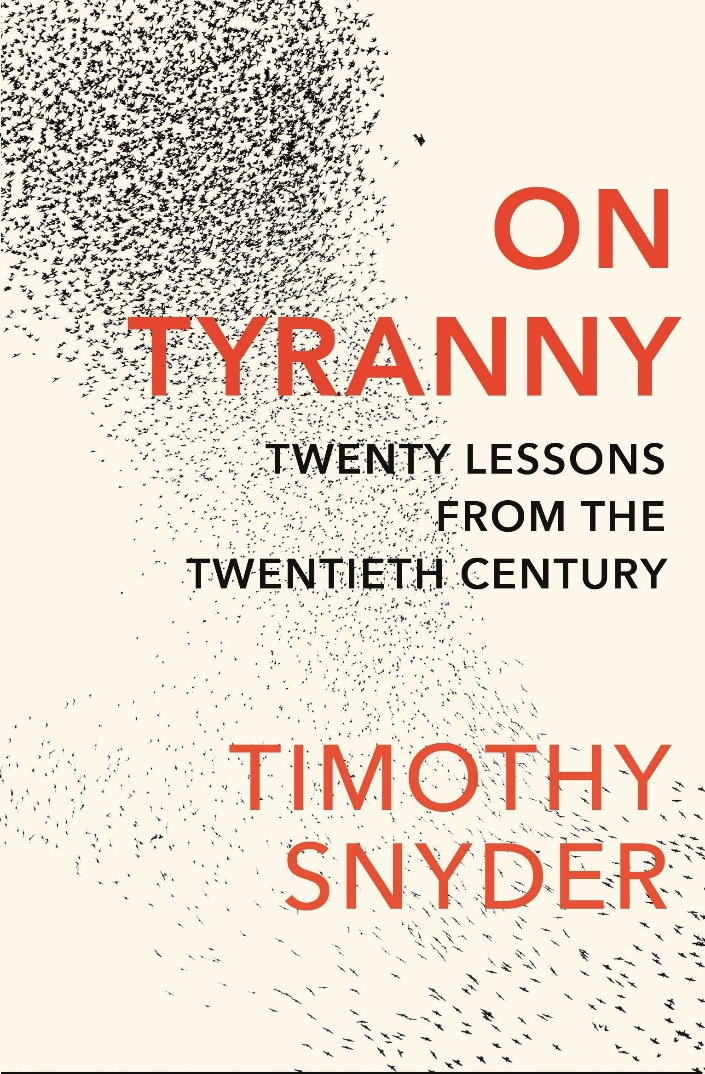
Book Title: On Tyranny: Twenty Lessons from the Twentieth Century
Author: Timothy Snyder
Publisher: Tim Duggan Books, 2017
ISBN: Ebook, 9780804190121

On Tyranny: Twenty Lessons from the Twentieth Century was a response to Donald Trump’s victory in the 2016 elections that made him the 45th president of the United States of America. According to Timothy Snyder, Trump’s victory, though surprising to American pollsters, was not so to watchers elsewhere, who clearly saw and understood America’s drift towards fascism. Although Americans prided themselves as essentially democratic and lovers of freedom, happenings leading to the 2016 U.S. presidential election and after illustrate how even a beacon and shining light of democracy can be threatened with possible collapse and erosion of democratic norms by a demagogic leader with a mass and rabid following that was prepared to shunt basic human decencies aside for Trumpist nativism.

On Tyranny offers twenty lessons he distilled from his reading of twentieth century western history in the quest for the enthronement of democracy and basic freedoms against the continuous threats posed by fascism and tyranny, which often seeks to take away hard-won freedoms through repression of citizens and attacks on critics and civil society. All the twenty lessons elaborated by the author offers valuable lessons for lovers of liberty and democracy all over the world.

The first lesson, calls for citizens not to obey in advance. That even in the face of overwhelming authority and the coercive force of a state about to turn repressive, the concerned citizen and officials of state, especially those in law enforcement should not offer anticipatory obedience to the tyrant. The call is for citizens in a democracy to guide against instinctive acquiescence to the perceived agenda of an authoritarian state and its leadership, who using that initial anticipatory obedience will grow even more oppressive, having rightly gauged and perceived what was possible.

In autocracies anticipatory obedience provides the basis for eventual and sustained erosion of the rights of citizens, especially minorities or those seen as opposing the state, or those that tyrants choose to brand as traitors. Not offering anticipatory obedience by not obeying in advance makes it more difficult for rights, norms and rules to be circumscribed. It is also crucial for upholding justice and doing what is right and takes us to Snyder’s second lesson, which is a call to defend institutions. Here the call is for citizens and those charged with managing state institutions to recognize the very important role that these institutions play and to defend them against capture by tyrants. The institutions of justice, law, security, labour unions, the free press, and general governance should not be at the whims of a single individual or clique, but most serve the common good of all. Institutions in democratic states will not preserve themselves except if citizens make it a duty to safeguard and defend them against capture by special interests. Citizens must guard against autocrats who wish to corrupt institutions or change the purpose for which they were instituted.

In the twentieth century, not just in the west, but across the world, the institution of the political party came to constitute the dominant platform for acquiring control of the state for both authoritarian regimes and democracies. In countries where political freedom was respected, multiparty systems emerged, but in autocratic and tyrannical regimes what often evolved was a state of affairs where once a party became dominant it excluded all others in one-party states. Apart from the military regimes, Nigerian democracy has evolved as a multiparty systems and institutions like the judiciary and the people’s eternal vigilance is contributing to maintaining this desirable status quo. But like Snyder warns, we must be beware of the one-party state and guard against its emergence in Nigeria. In addition to the multiparty system, citizens must also ensure that the electoral system is free and fair of manipulation and that as much as possible the vote of all Nigerians must be given equal consideration. To guard Nigerian democracy, citizens must not slacken and must maintain political consciousness. They should participate in the electoral process and endeavour to vote.

Each of Snyder’s twenty lessons is a call to action, to show courage, to persevere and be steadfast. The individual citizen and the national collective is called upon as highlighted by his quotation of the American Wendell Phillips to note that “eternal vigilance is the price of liberty [and that] the manna of popular liberty must be gathered each day or it is rotten.” Meaning that democracy cannot be safeguarded with inertia. It must be active. Physical and intellectual. The fourth lesson is especially exhortative. It calls for taking responsibility of the face of the world. The call is for standing up against the dehumanization of fellow human beings in the name of whatever ideology or propaganda propelling should categorization. In the Soviet Union, prosperous farmers, and in Germany, Jews, were physically marked as being outside the recognized norms, thus excluding them from the mainstream of society. This is something that we must guard against in Nigeria. Never must we categorise a subset of Nigerians such as to exclude them.

The fifth lessons, is crucial not just for safeguarding democracy and freedoms, but its absence throws a nation off course in its paths towards human and material development. The place of upholding professional ethics in the public space is essential for having an orderly and progressive society that makes a rules-based society possible as opposed to one in which authoritarians command civil servants to circumvent due process for aims that fall outside the law.

In Nigeria, it will be important for professionals and servants of the state to uphold their professional ethics. Doing so will guide against undertaking acts that circumscribe existing laws and norms. As much as possible the law and institutions must not be put in the service of conducts beyond that for which they were created. Citizens in positions of authority should strive to understand what the purpose of the law and their offices are, and what is meant by right conduct and how to be firm and fair in the universal discharge of their duties.

The state of security in Nigeria’s democracy over the past decade has deteriorated. As such many actors have called for the establishment of militias across the country. This is a state of affairs that Snyder warns against. He notes that history has shown that “Armed groups first degrade a political order, then transform it.” From what we have seen of insurgency and banditry this is a dangerous call. The state should strengthen or establish forces for safeguarding the polity, this could include state policing, but anything outside of that is a call towards anarchy. The history of the SS in Germany shows the danger of violent groups getting involved with politics. When they do is to create a climate of fear instead of one of reason. Citizens should be wary militias in Nigeria. The vital point to note being that it is dangerous for “agencies beyond the state” to have access to violence or the ability to organize violence. The state must imbue itself with the ability to completely and comprehensive curtail the existence of such groups.

The seventh lesson is directed to law enforcement officers. It states that “be reflective if you must be armed.” While members of the armed forces and the police are vital to a secured democracy and polity, they are also often accused of committing terror against citizens. The #Endsars protests brought the horrors perpetrated by a special unit of the Nigerian police against citizens to the fore. Thus men who bear arms must be reoriented to see themselves as servants and not masters of the people. The armed services must be true guardians. Additionally, the armed services and the police must and should resist collusion with the state to perpetrate evil against citizens – minorities, or against certain groups and interests and political opponents and should guard against collusion to rig elections.

While the focus has largely been on what citizens can do either in individual capacity or in positions of authority, the eighth lesson extend the analysis on doing the right thing at the level of the individual, group and fundamentally at the level of the state. It admonishes the individual, the institutions and the state to stand up for what is right, to do the right thing and to set the right example. The fundamental message of the lesson – to stand out – is that one should be counted as resisting injustice or retribution against self and others. That when evil circumstances arise, the individual should not accommodate himself to the changing circumstances and blend in, but should resist. Snyder provides the example of Poland standing up to Nazi Germany and of Winston Churchill’s resistance to Adolf Hitler that defined the British as a people who would resist evil. Churchill’s actions showed how he refused to obey or concede to Hitler in advance and in providing British resistance altered Hitler’s plans.

In Timothy Snyder’s ninth lesson, an evaluation of the importance of books and reading is succinctly provided. He calls for the citizen to read literature, political and historical texts and to endeavour to think for themselves, difficult as the task of actually thinking for oneself is. The emphasis of this lesson is that knowledge is important for citizenship in a democracy and for a free society. Reading is important in broadening and advancing individual and collective freedoms. Through reading we are given the language to articulate a broad range of thoughts without the restraints and constraints that authoritarians seek to promote.

One of the things to emerge with Donald Trump unfortunate presidency was that president emphasis on so-called alternative facts or the introduction into the vocabulary of phrases like “post-truth era.” This came along with the disdain for science, and for facts. This twenty-first incarnation of a world beyond facts would have been recognizable to authoritarian in earlier eras in Germany, the Soviet Union and China whose use of propaganda was designed to mask the reality of their atrociousness. The tenth lesson of “believe in truth” is one that is indispensable as “To abandon facts is to abandon freedom. If nothing is true, then no one can criticize power, because there is no basis upon which to do so. If nothing is true, then all is spectacle.”

The citizen must therefore endeavour to adhere to truth and not the propaganda of those in power or demagogues who seek to obscure. This is because facts are important. Facts should form the basis for what is true and false. Presenting of alternative facts as real leads to “the creation of a fictional counterworld,” which is a state of un-freedom to be avoided. This can be done through understanding the strategies of those who intend to subvert reality through their hostility to what is truthful and verifiable. There is a clear danger in having a state that calls on citizens to abandon reason and which projects the avocation in the supreme ability of leaders to provide all answers and solution, when they clearly have no capacity for such. This is what must be resisted. A collective arrival at the junction of a post-truth society always portends disaster for such a polity.

The eleventh lesson calls for finding out about the state of things in the world by oneself. Not lending oneself to fall for any propaganda campaign without due diligence. It fundamentally asserts that we “Take responsibility for what we communicate to others.” Thus, “If you are verifying information for yourself, you will not send on fake news to others.” In the light of this, Snyder’s conclusions are that good journalism and mainstream journalism is very important for democracy. It is important to acknowledge that sending fake news and conspiracy theories to others is a cancer of the era. Citizens should investigate. Seek the truth. And try to make the internet not a source of harm to the minds and intellect of others.

In the twelfth lesson, Snyder calls for engagement with others and the society around us. Essentially citizens of whatever diversity should be in touch with each other. Be involved in community affairs and strive to practice responsible citizenship. In times of crisis old and new friends are important for survival. Like the twelfth lesson, the thirteenth is also about enlightened self-preservation. It calls for practicing corporeal politics through associating with diverse entities and going beyond one’s regular associations and seeking out the unfamiliar. For instance if you are an intellectual, associate with labour, seek out the journalists and mingle with politicians and other civil society. Such diversity can more readily be harnessed to resist tyranny.

In the fourteenth lesson, engaged citizens, those concern with confronting and righting wrongs should be careful about their private lives. They must protect it. This is because authoritarians will seek out private information to violate their privacy and limit their effectiveness. Protecting one’s privacy will prevent those in power from deriving the hooks upon which to hang citizens considered as troublesome to authority out to dry. Thereby, protect your private life, else the unscrupulous can use it to compromise you.

Another vital lesson distilled by Timothy Snyder is that citizens should contribute to good causes. That citizens should make the effort to support civil society organs through non-political action. The importance of such supports is located in the understanding that: “Sharing in an undertaking teaches us that we can trust people beyond a narrow circle of friends and families, and helps us to recognize authorities from whom we can learn. The capacity of trust and learning can make life seem less chaotic and mysterious, and democratic politics more plausible and attractive.” Citizens should be involved in civic matters; support civil society organizations with time and resources. It is important in this regard to protect the freedom to associate freely and to form groups. This is because in all instances, authoritarians abhor free associations and civil society organisations.

To learn from peer in other countries. Snyder’s sixteenth lesson is one that deserves to be taken seriously in Nigeria. At the level of development of our polity in the spheres of democracy, science and education and civil society we have a lot of learning to catchup on. It is important to make friends from abroad and learn from them. For Snyder, if Americans have been quick to learn from Ukrainians, the Russians might have had a harder time infiltrating the 2016 presidential election in the United States through cyber-attacks as they did. Beyond electoral meddling, in all aspects of human endeavour other countries offer valuable experiences that other nations can learn from.

The seventeenth lesson is about how the state can stealthily and circumstantially erode the rights of citizens and in doing that shunt aside the basic tenets of the rule of law. Citizens are admonished by Snyder to look out for situations where the state calls for exceptions and declares emergencies in fighting either crime, terrorism or insurgency. Thus, citizens should be wary of “exceptions” in the fight against terrorism, whereby there are calls to circumvent the rule of law. States desire for emergency powers usually establishes dangerous precedents that soon become the unfortunate norm. Insisting on the rule of law is the right action that responsible citizens should take. It is necessary to be wary and very circumspect of authorities that seek opportunities in terrorist events to do away with liberties of the people in the name of terror management or fighting terrorism. Germany, the United States and Russia through different administrations utilized the pretext of terror to chip away at the freedoms and civil liberties of their citizens.

Being wary of exceptions, takes us to the next lesson; the place of courage in the face of state terror and propaganda. This refer to instances of state violence on citizens and through policies that erodes checks and balances and the rule of law. In the face of such, the citizen should take action, write, speak and lobby against laws or state policies that limits a free press, political participation, or the dissolution of opposition parties or actions that erode privacy. Citizens are to be courageous against such initiatives from those in power. Timothy Snyder describes the nature of the required courage thus: “Courage does not mean not fearing, or not grieving. It does mean recognizing and resisting terror management right away, from the moment of the attack, precisely when it seems most difficult to do so.” Which as his twentieth lesson outlines, “If none of us is prepared to die for freedom, then all of us will die under tyranny.”

If there is anything like global citizenship or global brotherhood, Snyder calls for it in his nineteenth lesson. He emphasises the difference between nationalism and patriotism whereby serving your country is patriotic. Patriots “wants the nation to live up to its ideals, which means asking us to be our best selves. A patriot must be concerned with the real world, which is the only place where his country can be loved and sustained. A patriot has universal values, standards by which he judges his nation, always wishing it well – and wishing that it would do better.” Nationalist relativism, however, considers others as lesser and draws on our baser instincts towards ethnicism, sectionalism and religious bigotry.

This work was a response to the emergence of the Trump presidency after victory in the 2016 polls. The administration that emerged projected an authoritarian bent with disregard for norms and decency and projection of a post-truth society. Snyder’s perception of the 45th president administration as anti-democratic would be proven with the Donald Trump’s sanctioned coup on the Capitol on 6 January 2021 after he had lost the 2020 American presidential election to Joe Biden. In some definite measure, this 2017 book made the defeat of Trump possible. It alerted Americans on the need for eternal vigilance. It pointed out the direction that Trump was unfortunately taking the country towards and what patriotic Americans should do to salvage American democracy. And, because American citizens and institutions were responsive, democracy in the United States eventually prevailed.

Snyder’s context in this work is of a developed and well-fed prosperous literate western society. Nigeria’s, is one in which conditions of material existence are less benign, but which offers itself as one of opportunity to lay the foundations for a prosperous, just and egalitarian society, where the fruits of development can be cultivated for the mutual benefits of all. Nigerian democracy since the dawn of the Fourth Republic has much to recommend it. Nigerians and the leadership have largely shown due diligence and the institutions that provide checks and balances have kept civil liberties intact and authoritarian aspirations under control. Citizens should continue to ensure eternal vigilance.

Terhemba Wuam is a Professor with the Department of History, Kaduna State University, Kaduna, Nigeria. He is co-editor of Challenges and Prospects of Development in Twenty-First Nigeria (Bahiti and Dalila Publishers, 2019).
 NIGERIA REVIEW OF BOOKS